
Best overall: the hardware your exact calibration requires. Best for repeated acceleration on a turbocharged engine: a compatible intercooler upgrade. Best restraint-first choice: retain serviceable factory parts unless the tune specifies replacements. The best stage 2 supporting mods in 2026 solve a documented requirement—not a generic shopping list.
- Choose stage 2 supporting mods from the exact calibration requirements, not a universal parts list.
- ECAConcepts custom ECU tuning serves Audi and Volkswagen owners; flashing hardware is included with the tune.
- Prioritize required hardware, engine health and fuel compatibility before optional intake or exhaust changes.
- Treat intercoolers, ignition parts and transmission changes as application-specific decisions, not automatic upgrades.
Why this matters
Stage 2 is a tuning label, not a standardized hardware specification. Different engines and calibrations use that label differently, so a part recommended for one Audi or Volkswagen does not establish a requirement for another.
ECAConcepts custom ECU tuning is best for Audi and Volkswagen owners seeking a calibration for their vehicle rather than a standalone flashing tool. ECAConcepts includes flashing hardware with the tune; it does not sell the supporting performance parts discussed here.
For a daily driver, the useful question is not how many modifications you can fit. It is which changes the calibration requires, which address an actual limitation, and which add expense or inconvenience without serving your driving needs.
What makes the best stage 2 supporting mods?
Use these criteria before comparing parts for a 2026 build:
- Calibration compatibility: The component matches the tune's documented requirements for your exact vehicle and ECU.
- Fuel compatibility: The calibration matches the fuel you can consistently obtain and use.
- Demonstrated need: The modification addresses required airflow, temperature control, ignition condition or drivetrain capacity.
- Daily usability: Noise, vibration, installation access and maintenance suit how you use the car.
- Legal suitability: The installation preserves required emissions equipment and meets applicable road-use rules.
- Installation completeness: You understand any supporting fittings, calibration changes and checks needed before driving.
A modification fails the buying test when its seller cannot explain how it fits your engine and calibration. A broad platform description is not enough to establish ECU, transmission or fuel compatibility.
Stage 2 supporting mods at a glance
This is a ranked decision guide, not a universal fitment list. Each recommendation earns its place through a different use case.
| Rank and option | Best for | Standout function | Key limitation |
|---|---|---|---|
| 1. Calibration-required hardware | Meeting the tune's installation requirements | Makes the physical configuration match the calibration | Requirements differ between engines and files |
| 2. Intercooler upgrade | Repeated acceleration with a turbocharged engine | Removes heat from compressed intake air | Fitment and effectiveness depend on the system |
| 3. Specification-correct ignition service | Replacing worn or unsuitable ignition components | Restores the specified ignition condition | Colder plugs and smaller gaps are not universal upgrades |
| 4. Transmission-specific support | Matching drivetrain requirements to engine output | Addresses documented clutch or control requirements | ECU and TCU tuning are separate decisions |
| 5. Compatible intake system | Meeting a documented inlet requirement | Changes the air path into the engine | Some changes affect sensor readings or add noise |
| 6. Road-legal exhaust changes | Changing exhaust sound or meeting a documented requirement | Alters the exhaust system's flow path and sound | Legal status and calibration compatibility need verification |
1. Calibration-required hardware: best for correct installation
Start with the exact requirements of the ECU calibration you intend to buy. Depending on the application, those requirements can concern intake hardware, charge-air cooling, fueling or other engine components; none becomes mandatory simply because a listing says stage 2.
Get the requirements before ordering parts. A component that physically bolts onto the engine still needs to match the calibration's assumptions, including sensor arrangement and fuel specification.
Calibration-required hardware pros:
- Gives you a defined purchase list rather than an open-ended build.
- Keeps hardware selection tied to the engine calibration.
- Separates necessary work from preference-driven modifications.
Calibration-required hardware cons:
- A list from another engine or tuner is not transferable evidence.
- Required changes can introduce additional installation and maintenance work.
Best for: Owners who have selected a specific calibration and need to establish its prerequisites.
For your 2026 purchase, request written confirmation of the required configuration. Verdict: Buy only the hardware confirmed for the exact tune; hold everything else.
2. Intercooler upgrade: best for repeated turbocharged acceleration
An intercooler removes heat from compressed intake air. For a turbocharged daily driver, a compatible upgrade belongs on the shortlist when temperature control is a documented limitation or the calibration requires different cooling hardware.
Do not choose by external size alone. Core design, airflow, pressure drop and installation all affect the result, and a larger-looking component does not establish better performance on your vehicle.
Intercooler upgrade pros:
- Addresses charge-air temperature rather than exhaust sound.
- Supports a cooling-focused build when the application warrants it.
- Offers a measurable comparison through operating data under comparable conditions.
Intercooler upgrade cons:
- Installation requirements vary by chassis and cooling layout.
- Poor fitment or connections can introduce charge-air leaks.
- Results from a different vehicle do not establish your result.
Best for: Turbocharged applications with a confirmed cooling requirement or evidence of temperature-related performance reduction.
Compare repeatable operating conditions, not an isolated temperature screenshot. Verdict: Buy when required or supported by operating data; hold when the need is unproven.
3. Specification-correct ignition service: best for worn components
Spark plugs are maintenance components, not an automatic source of additional power. Replace worn or unsuitable plugs with the specification confirmed for the engine and calibration; do not assume that every tuned Audi or Volkswagen needs a colder plug or reduced gap.
A misfire needs diagnosis. Replacing every coil without identifying the fault can leave a fueling, wiring or mechanical problem unresolved.
Specification-correct ignition service pros:
- Addresses component condition before adding engine load.
- Provides a clear specification to verify during installation.
- Avoids treating decorative or branded ignition parts as evidence of performance.
Specification-correct ignition service cons:
- Fresh plugs do not correct every cause of misfire.
- An unsuitable heat range or gap creates another variable to diagnose.
Best for: Vehicles with due maintenance, uncertain service history or ignition components outside the confirmed specification.
Inspect condition and follow the relevant installation instructions, including tightening requirements. Verdict: Buy required service parts; skip speculative ignition upgrades.
4. Transmission-specific support: best for drivetrain requirements
An ECU tune changes engine control; a TCU tune changes transmission control. They are not interchangeable, and an engine tune does not establish that your transmission needs—or supports—a separate calibration.
For a manual transmission, clutch condition and the intended torque demand matter. For an electronically controlled transmission, confirm the exact transmission identification and any documented calibration requirements before choosing a TCU service.
Transmission-specific support pros:
- Treats the drivetrain as part of the purchase decision.
- Separates mechanical clutch capacity from transmission software.
- Makes transmission compatibility an explicit check rather than an assumption.
Transmission-specific support cons:
- A TCU calibration does not repair worn mechanical components.
- Clutch changes can alter pedal feel and everyday refinement.
- Transmission recommendations are not interchangeable across models.
Best for: Owners whose selected tune specifies drivetrain support or whose diagnosed clutch condition requires attention.
Do not purchase a transmission tune solely because the engine tune carries a stage label. Verdict: Buy confirmed drivetrain support; hold unspecified TCU or clutch changes.
5. Compatible intake system: best for a documented inlet requirement
An intake changes the route air takes into the engine and can change induction sound. Whether it belongs on your build depends on the calibration requirements, the original intake arrangement and the replacement's fitment.
On systems that meter intake airflow, changes around the sensor can affect its reading. Confirm the intended sensor housing and connections instead of assuming any intake with the correct mounting points is compatible.
Compatible intake system pros:
- Can satisfy an explicitly stated calibration requirement.
- Allows selection around the correct airbox and sensor arrangement.
- Provides an intentional sound change when that is your goal.
Compatible intake system cons:
- Additional induction noise is not proof of additional power.
- Fitment or sensor changes can introduce diagnostic problems.
- Filter access and maintenance requirements differ between designs.
Best for: Owners whose calibration specifies an intake change or who want a verified, compatible sound modification.
Keep a serviceable factory intake when no documented requirement justifies replacing it. Verdict: Buy for a confirmed requirement; skip sound-led purchases disguised as necessities.
6. Road-legal exhaust changes: best for sound preferences
Exhaust changes need a clear purpose: sound, a documented hardware requirement, or replacement of a defective component. A cat-back exhaust changes components downstream of the catalytic converter; it is not interchangeable with a downpipe or a change to emissions equipment.
Do not interpret stage 2 as permission to remove a catalyst or disable an emissions monitor. In the United States, federal law prohibits tampering with required emissions controls, and local requirements also affect road use.
Road-legal exhaust changes pros:
- Lets you choose sound separately from the ECU calibration.
- Encourages checking component scope before installation.
- Keeps emissions compliance in the buying decision.
Road-legal exhaust changes cons:
- Added noise or cabin drone can reduce daily comfort.
- A product's marketing description does not establish road legality.
- An exhaust change does not guarantee a power gain.
Best for: Owners seeking a verified legal sound change or fulfilling a documented, compliant hardware requirement.
In 2026, check current rules and the actual component documentation before purchase. Verdict: Buy verified compliant changes for a defined purpose; skip emissions-delete hardware.
Check the car before choosing the parts
A healthy baseline comes before a modification list. Existing misfires, leaks, warning lights or cooling faults need diagnosis before you add a calibration intended to change engine output.
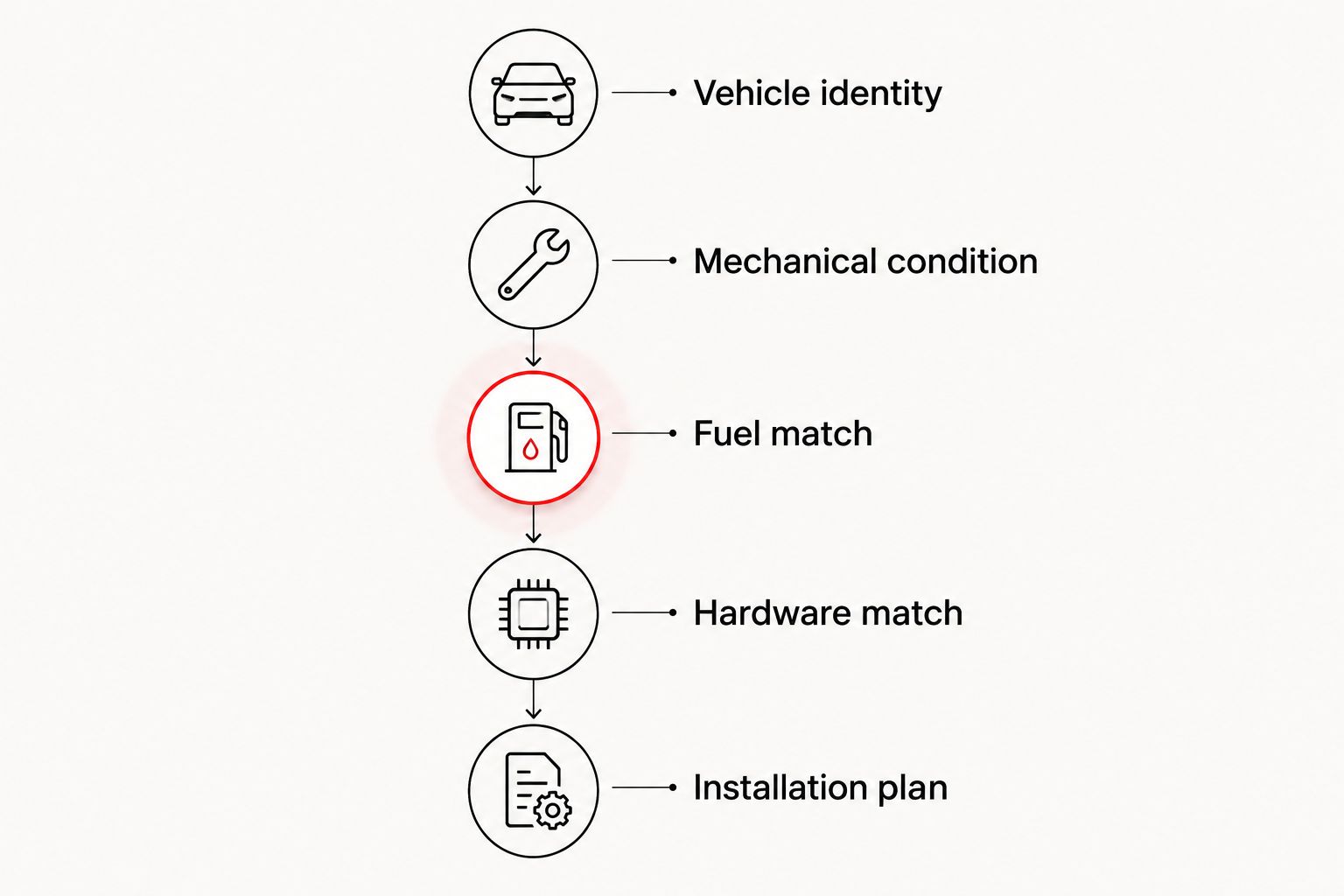
Use this sequence to prepare a 2026 daily-driver purchase:
- Vehicle identity: Record the model year, engine identification, ECU information and transmission identification requested for compatibility checking.
- Mechanical condition: Resolve diagnosed faults and establish the relevant maintenance history.
- Fuel match: Confirm the calibration's fuel specification and whether your normal filling stations meet it.
- Hardware match: Compare installed components with the tune's written requirements.
- Installation plan: Confirm flashing instructions, power-supply requirements and the post-installation checks.
Do not improvise flashing procedures from an unrelated video. ECAConcepts includes flashing hardware with its custom ECU tuning, but the correct procedure and compatibility still need confirmation for the specific purchase.
How the recommendations are ranked
This ranking puts calibration requirements first, followed by application-specific cooling, ignition condition and drivetrain needs. Intake and exhaust changes rank lower because neither is universally required by the stage 2 label.
The ranking describes purchase priorities, not measured power results or a parts test. No horsepower gain, temperature improvement or transmission capacity is assigned without application-specific evidence.
Which supporting mods should you choose?
Choose the smallest documented parts list that meets your calibration's requirements and addresses your car's condition. For a daily driver, that is a better starting point than buying an intake, exhaust, intercooler and ignition package by default.
For a 2026 build, separate the list into required hardware, diagnosed maintenance and optional preferences. Approve the first two before spending on the third; sound and appearance should remain deliberate choices, not assumed prerequisites.
FAQ
What are the best stage 2 supporting mods for an Audi or Volkswagen?
The best stage 2 supporting mods are the components required by the exact ECU calibration, followed by changes that address documented limitations. Confirm vehicle, ECU, fuel and transmission compatibility before buying parts.
Does every stage 2 tune need a downpipe?
No, stage 2 does not define a universal downpipe requirement. Check the calibration’s exact hardware requirements and do not remove or disable required emissions controls.
Do I need an intercooler for a stage 2 daily driver?
An intercooler upgrade belongs on the list when the calibration requires it or operating data establishes a cooling limitation. The stage label alone does not establish that requirement.
Should I fit colder spark plugs before tuning?
Fit the spark plug specification confirmed for your engine and calibration. A colder heat range or smaller gap is not a universal requirement for tuned Audi and Volkswagen engines.
Is a TCU tune included with an ECU tune?
Do not assume a TCU tune is included with an ECU tune. Engine and transmission calibrations control different systems, so verify scope and transmission compatibility separately.
Can I buy a standalone flashing tool from ECAConcepts?
ECAConcepts supplies flashing hardware with its custom ECU tune, not as a standalone product for other tuners. It does not sell the supporting performance parts discussed in this guide.
Can I use my usual fuel after a stage 2 tune?
Use your usual fuel only when it meets the selected calibration’s confirmed specification. Resolve that match before purchase rather than assuming a different fuel is acceptable.
One last thing
A useful purchase document is not the longest modification list. It is a written match between your vehicle, installed hardware, normal fuel and selected calibration—with installation requirements you understand.
Ask for that match before ordering. A stage label cannot answer those questions for you.
Related guides
- Custom ECU tune options for Audi and VW
- ECU tune choices for the Mk7 GTI
- ECU tune choices for the Audi 2.0T
- Transmission tuning for Audi and VW DSG
Confirm your custom tuning requirements
Check vehicle compatibility, fuel requirements and required hardware before choosing your tune.