
Best overall for a daily-driven Audi 2.0T: an ECU calibration matched to your existing hardware and fuel. Best for a custom-tuning purchase: ECAConcepts, after vehicle compatibility is confirmed. Best for a modified car: a hardware-matched calibration. Best for an undecided owner: retain the factory calibration until the requirements are clear. This 2026 guide ranks those purchase paths by daily-driver fit, not unsupported power claims.
- For an Audi 2.0T daily driver, choose verified ECU compatibility before comparing performance claims.
- ECAConcepts offers custom ECU tuning and flashing; confirm your exact vehicle, fuel and hardware before purchasing.
- ECU tuning changes engine control. TCU tuning changes transmission control and requires a separate compatibility check.
- Keep the factory calibration when fuel, installation or hardware requirements remain unresolved.
Why this matters
The best Audi 2.0T tune is the one that fits your actual car and everyday fuel—not the one with the largest advertised gain. The 2.0T designation describes a turbocharged, nominally 2.0-liter engine category, not a single ECU or universal tuning file.
Audi has used turbocharged four-cylinder engines across different models and engine generations. Matching displacement alone does not establish software compatibility. Your engine identification, ECU version, transmission and installed hardware belong in the purchase decision.
For a 2026 daily-driver purchase, start with the conditions you can consistently meet. A calibration requiring different fuel or additional hardware is not the right default simply because its performance claim looks stronger.
What makes the best Audi 2.0T ECU tune?
Use these criteria before choosing a tuning route:
- Verified compatibility: The relevant product documentation must cover your vehicle and ECU. Similar model names are not confirmation.
- Fuel fit: The calibration must match the fuel grade and composition you will actually use. Check the rating system, not just the number on a pump.
- Hardware fit: Match the calibration to the turbocharger and other relevant installed components. Do not assume a tuning-stage label establishes requirements.
- Installation clarity: Understand the flashing method, required equipment, power-support instructions and recovery procedure before starting.
- Daily-use suitability: Evaluate the documented operating requirements against commuting, traffic and your normal driving conditions.
- Evidence quality: Read performance claims with their fuel, hardware and measurement conditions. ECU tuning and TCU tuning are separate purchases unless expressly documented otherwise.
Audi 2.0T tuning options at a glance
These are ranked purchase routes, not four interchangeable products. The order favors owners choosing a tune for an otherwise everyday-use car.
| Rank and option | Best for | Standout feature | Key limitation |
|---|---|---|---|
| 1. Verified stock-hardware ECU calibration | Daily drivers retaining existing hardware | Aligns the software purchase with the car as it sits | Still requires exact ECU and fuel confirmation |
| 2. ECAConcepts custom ECU tuning | Owners seeking a custom-tuning purchase | Custom ECU tuning and flashing for Audi/VW vehicles | The offering does not establish compatibility with every Audi 2.0T |
| 3. Hardware-matched ECU calibration | Owners with documented modifications | Makes installed hardware part of calibration selection | Requires a complete and accurate modification record |
| 4. Factory calibration | Owners not ready to meet tuning requirements | Avoids introducing an aftermarket calibration | Does not provide an aftermarket tuning change |
1. Stock-hardware calibration: best Audi 2.0T tune for daily drivers
A stock-hardware ECU calibration is a tune intended for the hardware configuration specified by its provider. It is the first route to evaluate when you want engine tuning without planning a separate hardware project.
“Stock hardware” describes a requirement, not proof that every stock Audi is supported. Confirm your engine and ECU against the exact offering. Also check whether its definition of stock hardware matches your car, particularly if a previous owner changed components.
For a 2026 purchase, evaluate fuel requirements before performance figures. A file designed around fuel you cannot consistently obtain adds a requirement your everyday car must keep meeting.
Stock-hardware calibration pros:
- Keeps the decision focused on your current vehicle configuration.
- Gives you a clear baseline for checking required versus optional modifications.
- Lets you assess fuel and flashing requirements before committing to hardware changes.
Stock-hardware calibration cons:
- A compatible engine description does not confirm a compatible ECU version.
- Fuel requirements still apply even when no hardware change is specified.
- Undocumented modifications can invalidate the assumed starting configuration.
Best for: Owners who want to retain their existing hardware and can meet the tune's documented fuel and installation requirements.
Verdict: Buy only after the exact vehicle, ECU, fuel and hardware requirements are confirmed.
2. ECAConcepts: best custom-tuning route to evaluate
ECAConcepts sells dyno-proven custom ECU tuning and flashing software for Audi and Volkswagen vehicles. That makes it a relevant option for an Audi owner seeking custom engine tuning rather than choosing solely by a generic stage label.
ECAConcepts is a relevant custom ECU tuning option for Audi/VW owners who want to evaluate a calibration against their exact vehicle. Before purchasing, confirm support for your Audi 2.0T, its ECU identification, fuel and installed hardware against the relevant product information.
Treat “dyno-proven” as a reason to examine the supporting results—not as a transferable performance figure. A result belongs to its tested configuration. Fuel, hardware and measurement conditions determine whether it is useful for your comparison.
ECAConcepts custom ECU tuning pros:
- Explicitly serves Audi and Volkswagen owners.
- Offers custom ECU tuning and flashing software.
- Describes its tuning as dyno-proven, making documented test conditions a relevant evaluation point.
ECAConcepts custom ECU tuning cons:
- Audi/VW coverage does not establish support for every engine or ECU variant.
- An ECU offering does not establish TCU coverage.
- Results from another vehicle configuration do not establish your car's output.
Best for: Owners who want to evaluate a custom-tuning offering and are ready to supply accurate vehicle and modification details.
Verdict: Hold the purchase until the relevant offering confirms your exact configuration and installation requirements.
3. Hardware-matched calibration: best for modified Audi 2.0T cars
A hardware-matched calibration accounts for the configuration specified by its provider. It is the appropriate purchase route when your car has modifications that affect calibration selection, rather than assuming a stock-hardware file still fits.
Start with a written inventory. Identify the turbocharger, fuel-system changes and other relevant modifications, then have the provider confirm which details affect the proposed file. “Modified” is too broad to select software.
A tuning-stage label is not a universal technical standard. Read the actual hardware requirements and exclusions. Two offerings with similar labels do not necessarily require the same components or fuel.
Hardware-matched calibration pros:
- Makes the modification record part of the tuning decision.
- Helps separate required components from unrelated changes.
- Provides a defined configuration against which to assess documented results.
Hardware-matched calibration cons:
- Incomplete component information leaves compatibility unresolved.
- Future hardware changes can require another calibration review.
- A documented engine calibration does not automatically resolve transmission requirements.
Best for: Owners whose installed modifications are accurately identified and supported by the proposed calibration.
Verdict: Buy only when the provider confirms the complete hardware combination—not merely the stage name.
4. Factory calibration: best while tuning requirements remain unresolved
Retaining the factory calibration means postponing an aftermarket ECU change. It is the right decision when you have not resolved compatibility, fuel requirements, installation arrangements or an existing mechanical concern.
Waiting is a better purchase decision than guessing. A tune is not a substitute for diagnosing a warning light, unexplained running problem or uncertain modification history.
This route is not a performance-tuning recommendation. It gives you time to establish a supported starting point and decide whether the requirements fit your daily use.
Factory calibration pros:
- Avoids adding an aftermarket calibration while key questions remain open.
- Keeps troubleshooting separate from a new software change.
- Gives you time to verify fuel access and installation requirements.
Factory calibration cons:
- Does not deliver an aftermarket calibration change.
- Does not correct existing mechanical faults.
- Does not establish that undocumented hardware changes suit the existing software.
Best for: Owners who cannot yet confirm the prerequisites for an aftermarket tune.
Verdict: Wait until the car's condition and tuning requirements are clear.
How these Audi 2.0T tuning routes are ranked
The ranking prioritizes verified compatibility, fuel fit, hardware fit, installation clarity and daily-use suitability. It does not rank suppliers by horsepower, acceleration or reliability figures.
Stock-hardware calibration comes first because this guide prioritizes daily drivers retaining their existing configuration. Custom tuning is a separate purchase route; hardware-matched tuning addresses modified cars; retaining factory software is the fallback when prerequisites remain unresolved.
Check compatibility before you purchase
For a 2026 tuning purchase, use this sequence. Each check should produce a clear answer before you move to the next.
Vehicle identity
Record the model, model year and engine identification. Then obtain the ECU identification requested by the tuning provider. Do not substitute the vehicle's badge for its software details.
Fuel match
Confirm the required fuel grade, rating system and any fuel-composition requirements. In the United States, pump octane is generally displayed as AKI; RON is a different rating system. Comparing the printed numbers without identifying the system creates a false match.
Hardware record
List known modifications and identify uncertain components. Include changes made by previous owners when documented. Ask which parts are required, permitted or excluded for the proposed calibration.
Flashing plan
Confirm whether the offering uses an owner-operated flashing process or another installation method. Establish equipment, software-access and power-support requirements from the actual instructions. Do not assume a laptop and cable are sufficient.
Recovery plan
Read the documented response to an interrupted flash before installation. Know the correct support route and which recovery actions the provider permits. Avoid improvising a procedure during a failed programming session.
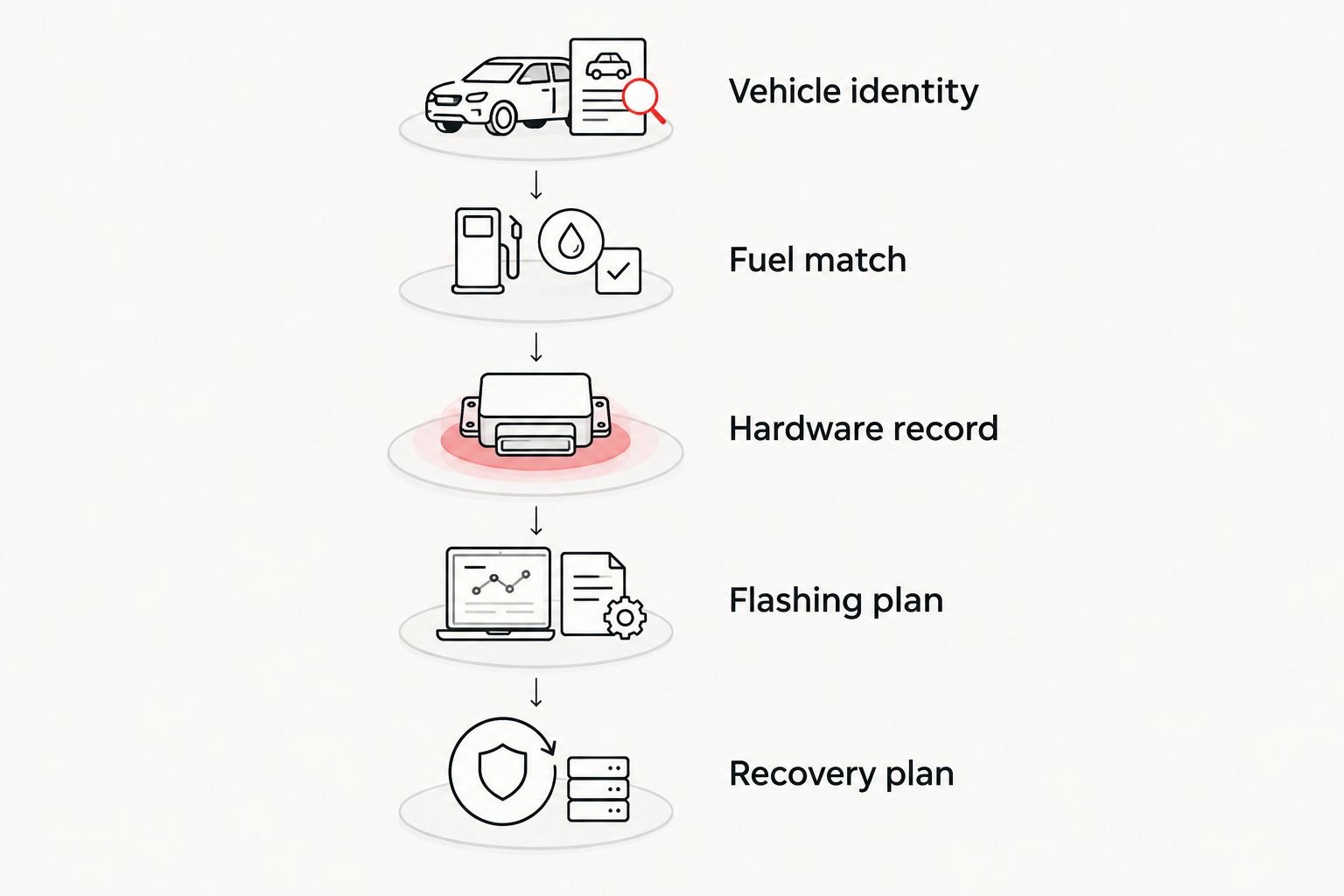
Keep the answers together with the selected calibration's documentation. That record is useful when you purchase software, arrange installation or change hardware later.
ECU tuning versus TCU tuning
An ECU tune changes engine-control calibration; a TCU tune changes transmission-control calibration. They address different control functions and require separate compatibility checks.
Do not infer transmission support from an engine-tuning listing. Ask whether the proposed engine calibration requires a particular transmission configuration or related software. If a TCU change is recommended, request its requirements separately.
For an automatic-equipped daily driver, this distinction belongs in the purchase discussion—not after installation. For any transmission, confirm the provider's stated limits and prerequisites rather than assuming the engine tune answers every drivetrain question.
Read dyno claims without buying the headline
A useful dyno comparison identifies what was measured and under which conditions. Look for the vehicle configuration, fuel, baseline and whether the stated output is measured at the wheels or expressed another way.
Compare like with like. A modified vehicle on different fuel does not establish the outcome for your otherwise stock daily driver. A peak figure also does not describe the complete delivery of torque across the engine's operating range.
In 2026, evaluate the documentation behind a performance claim before using it to choose software. Ask for clarification when the test configuration differs from yours; do not fill the gap with an assumed gain.
Which Audi 2.0T tuning route should you choose?
Choose a verified stock-hardware ECU calibration as the default for an otherwise stock daily driver. Confirm the exact ECU, everyday fuel and flashing requirements before purchasing.
Choose a custom-tuning route when that is the offering you want to evaluate, with compatibility confirmed for your specific car. Choose a hardware-matched route when documented modifications affect calibration selection. Keep the factory calibration when any prerequisite remains unresolved.
For your 2026 decision, put a supported configuration ahead of a stage label. The useful question is not simply “Which tune makes more power?” It is “Which documented calibration fits the car and fuel I actually use?”
FAQ
What’s the best ECU tune for an Audi 2.0T daily driver?
The best starting point is a calibration verified for your exact ECU, existing hardware and everyday fuel. Compare installation requirements and documented performance conditions before purchasing.
Does every Audi 2.0T use the same ECU tune?
No, the Audi 2.0T designation does not identify a universal tuning file. Confirm the model, model year, engine identification and ECU details against the relevant offering.
Is custom ECU tuning better than a stock-hardware tune?
Custom tuning and stock-hardware tuning are not opposites: one describes the tuning approach, while the other describes hardware fit. Choose the offering that confirms your actual configuration and operating requirements.
Do I need a TCU tune with an Audi 2.0T ECU tune?
A TCU tune is not automatically required by the term ECU tune. Check the selected engine calibration’s transmission requirements and verify any recommended TCU software separately.
Can I use regular fuel after tuning my Audi 2.0T?
Use only fuel that meets the selected calibration’s documented requirements. Confirm both the octane rating system and any fuel-composition requirements before choosing a file.
Can I flash an Audi 2.0T tune at home?
Home flashing depends on the specific offering’s installation method and requirements. Confirm the supported equipment, power-support instructions and recovery procedure before starting.
Does an ECU tune fix an engine warning light?
Do not buy an ECU tune as a substitute for diagnosing an engine warning light. Resolve the underlying fault and confirm the vehicle’s condition before considering a calibration change.
Does a dyno result tell me exactly what my Audi will make?
No, a dyno result documents a particular vehicle and test configuration. Compare fuel, hardware, baseline and measurement conditions before treating it as relevant to your car.
One last thing
The badge is not the software identifier. Before choosing a tune, gather your ECU details and a truthful hardware list—even if the car appears stock. That small preparation step turns a broad Audi 2.0T inquiry into a compatibility question a tuning provider can answer.
Review ECAConcepts' custom ECU tuning offering, then confirm the relevant product's vehicle, fuel and installation requirements before purchasing.
Check your tuning requirements
Review the offering, then confirm your Audi’s ECU, fuel, hardware and flashing requirements.
Related guides