
Best overall: a vehicle-matched custom ECU tune. Best for a daily driver: a stock-hardware calibration matched to your fuel. Best budget decision: retain the factory calibration until compatibility is confirmed. This 2026 Audi S4 tuning guide compares those routes with hardware-led tuning and coordinated ECU/TCU tuning; ECAConcepts provides custom ECU tuning and flashing for Audi and Volkswagen vehicles.
- The best Audi S4 tuning choice matches your ECU, fuel and installed hardware—not just your model badge.
- ECAConcepts provides custom ECU tuning; confirm support for your exact Audi S4 before buying.
- Daily drivers should prioritize documented stock-hardware requirements over headline performance claims.
- ECU tuning controls the engine; TCU tuning controls the transmission and requires separate compatibility checks.
- Keep the factory calibration when vehicle condition, fuel requirements or flashing support remain unresolved.
Why this matters
An Audi S4 badge does not identify the calibration your car needs. The S4 name spans different engine and transmission configurations, and a tune must match the actual control units and hardware fitted to your vehicle.
For Audi S4 tuning in 2026, choose the route before choosing the seller. A daily driver on unchanged hardware presents a different calibration problem from a modified car, while an engine tune and a transmission tune solve different problems. Buying by a stage label alone skips those distinctions.
ECAConcepts is best suited to Audi and Volkswagen owners seeking custom ECU tuning rather than a generic performance accessory. For an S4 purchase, verify exact vehicle support, installation requirements and calibration conditions before committing.
What makes the best Audi S4 tune?
Judge every candidate against these criteria before comparing claimed output:
- Exact compatibility: Confirm the vehicle identification, engine configuration, ECU identification and software version required by the tune provider.
- Fuel match: Establish the specified fuel and whether the documentation uses AKI or RON octane ratings. Those rating systems are not interchangeable.
- Hardware match: Confirm required components and distinguish mandatory modifications from optional additions.
- Flashing requirements: Identify the supported interface, software, power-supply requirements and recovery procedure before starting.
- Transmission coordination: Determine whether the engine calibration requires a separate TCU calibration, supports the existing transmission configuration or imposes restrictions.
- Documented evidence: Compare performance claims only when fuel, hardware, measurement method and test conditions are stated.
A useful product page answers those questions directly. If an essential requirement remains unclear, resolve it before purchase rather than treating the omission as permission.
Audi S4 tuning options at a glance
These are ranked purchase approaches, not a comparison of verified S4 products. Each route has a distinct purpose; the right choice depends on your car and intended use.
| Rank and option | Best for | Standout feature | Key limitation |
|---|---|---|---|
| 1. Vehicle-matched custom ECU tune | Owners needing calibration matched to their configuration | Vehicle-specific engine calibration | Exact S4 support and delivery requirements need confirmation |
| 2. Stock-hardware ECU tune | Daily drivers keeping existing engine hardware | A clearly defined hardware baseline | Still requires the specified fuel and compatible ECU |
| 3. Hardware-led ECU tune | Owners with documented engine modifications | Calibration selected around installed components | More dependencies to verify before flashing |
| 4. Coordinated ECU/TCU tuning | Automatic-transmission owners needing engine and gearbox coordination | Addresses separate engine and transmission controllers | TCU support is separate from ECU support |
| 5. Factory calibration | Owners resolving faults or uncertain fitment | Preserves the existing software baseline | Does not provide aftermarket calibration changes |
1. Vehicle-matched custom ECU tune: best for configuration-specific needs
A custom ECU tune changes engine-control calibration around a defined vehicle configuration. The important distinction is not the word custom: it is whether the supplier identifies your ECU, fuel, hardware and intended use before specifying the file.
The ECAConcepts Audi 3.0T Custom Tune page lists Audi S4 3.0T model years 2009–2021 in its fitment table. ECAConcepts custom ECU tuning is a relevant option for a listed S4 3.0T application when the exact engine, controller, fuel and hardware requirements are confirmed. Submit your Controller ID and modification list before choosing the file.
| Buyer question | What the ECAConcepts listing states | What to confirm |
|---|---|---|
| Which S4 application is listed? | Audi S4 3.0T, 2009–2021 | Exact engine generation, ECU and software |
| What defines the tune request? | Controller ID, modification list and goals | Fuel, hardware and validation requirements |
| What installation choices appear in the order form? | Windows Flash Tool, mobile flashing, programmed ECU and mail-in choices | Which choice supports your controller and what it includes |
The page describes a supercharged 3.0 TFSI while its year table spans multiple S4 generations. Treat that as a reason to confirm your actual engine and controller, not as proof that one file works across the entire range. Do not assume custom tuning includes an individual dyno session or unlimited revisions.
Custom ECU tune pros:
- Makes the actual vehicle configuration central to selection.
- Provides a route for addressing documented hardware requirements.
- Lets you assess the calibration against your intended use rather than a stage name.
Custom ECU tune cons:
- Requires accurate vehicle information from the owner or installer.
- The scope of customization, revisions and validation must be established separately.
Best for: Owners whose configuration needs an explicitly matched calibration, including buyers evaluating a custom tuning provider.
Before buying in 2026, ask what information determines the file selection and what evidence confirms that the calibration applies to your car. A seller's general Audi experience does not replace an exact fitment answer.
Verdict: Buy only after exact S4 compatibility and the calibration scope are confirmed.
2. Stock-hardware ECU tune: best for a straightforward daily driver
A stock-hardware ECU tune is intended for a specified factory-hardware configuration. It changes engine calibration without making an engine modification package the starting requirement, provided the product documentation confirms that arrangement.
This is the clearest route for a daily driver when you want to keep the existing engine hardware. However, stock hardware does not mean unrestricted fuel choice, unchanged servicing requirements or automatic compatibility with the transmission.
Stock-hardware ECU tune pros:
- Keeps the hardware baseline easier to identify.
- Avoids buying modifications that the documented calibration does not require.
- Gives you a defined starting point for evaluating drivability and installation requirements.
Stock-hardware ECU tune cons:
- Must still match the required fuel and ECU software.
- Does not account for unreported hardware changes or unresolved mechanical faults.
Best for: Daily drivers retaining factory engine hardware and willing to follow a clearly documented fuel specification.
Request an explicit list of supported and excluded configurations. If your car already has modifications, describe them rather than selecting this route because the changes look minor.
Verdict: Buy when the documented stock-hardware specification matches your car.
3. Hardware-led ECU tune: best for an already modified S4
A hardware-led ECU tune starts with the components fitted to the vehicle. The calibration must correspond to that configuration, not simply to the owner's desired output.
Write down every relevant modification before evaluating a file. Depending on the particular engine and calibration, changes to airflow, boost-related hardware or fueling can affect the requirements. The tune provider must define which changes matter for the supported application.
Hardware-led ECU tune pros:
- Makes component requirements explicit before calibration selection.
- Separates the needs of a modified car from a factory-hardware car.
- Supports a purchase decision based on an actual parts list.
Hardware-led ECU tune cons:
- Creates more compatibility dependencies than a factory-hardware configuration.
- Requires clear documentation when components from different suppliers are combined.
Best for: Owners with documented modifications who need a calibration selected around those components.
A stage label is not a technical specification. For Audi S4 tuning in 2026, compare the required hardware line by line; identical stage names from different suppliers do not establish identical requirements.
Verdict: Hold until the complete hardware configuration is accepted by the tune provider.
4. Coordinated ECU/TCU tuning: best for transmission integration
The ECU controls engine operation. The TCU controls an electronically managed transmission, including functions such as shift scheduling and transmission-specific control strategies.
An ECU tune is not a TCU tune, and buying engine software does not establish gearbox-software support. For a compatible automatic-transmission application, coordinated tuning means checking how the selected engine and transmission calibrations are intended to work together.
Coordinated ECU/TCU tuning pros:
- Treats engine and transmission software as separate compatibility decisions.
- Makes transmission requirements part of the purchase process.
- Allows supported combinations to be assessed as a complete configuration.
Coordinated ECU/TCU tuning cons:
- Adds another controller and software version to verify.
- Is not a universal requirement or an applicable solution for every transmission.
Best for: Automatic-transmission owners whose chosen engine calibration has documented transmission-calibration requirements.
Ask whether TCU tuning is required, optional or unsupported for the exact combination. Do not interpret a supplier's ECU offering as evidence that the same supplier provides a matching TCU product.
Verdict: Buy only when both controllers and the intended combination are explicitly supported.
5. Factory calibration: best while resolving faults or fitment
Keeping the factory calibration is a valid decision when the car has unresolved faults, uncertain modification history or unconfirmed flashing support. It preserves your current software baseline while you identify the problem or establish compatibility.
This route does not make an unhealthy vehicle healthy. It prevents a new calibration from becoming another variable during diagnosis.
Factory calibration pros:
- Avoids adding aftermarket software during fault diagnosis.
- Gives you time to document hardware and controller information.
- Removes pressure to buy a file before essential questions are answered.
Factory calibration cons:
- Does not deliver aftermarket engine-calibration changes.
- Still requires maintenance and investigation of existing symptoms.
Best for: Owners with warning lights, unexplained drivability problems, uncertain hardware or incomplete compatibility information.
If the vehicle is already tuned, do not assume that restoring factory software is a universal fix. Establish the installed hardware and the appropriate recovery or diagnostic procedure first.
Verdict: Wait on tuning until vehicle condition and compatibility are resolved.
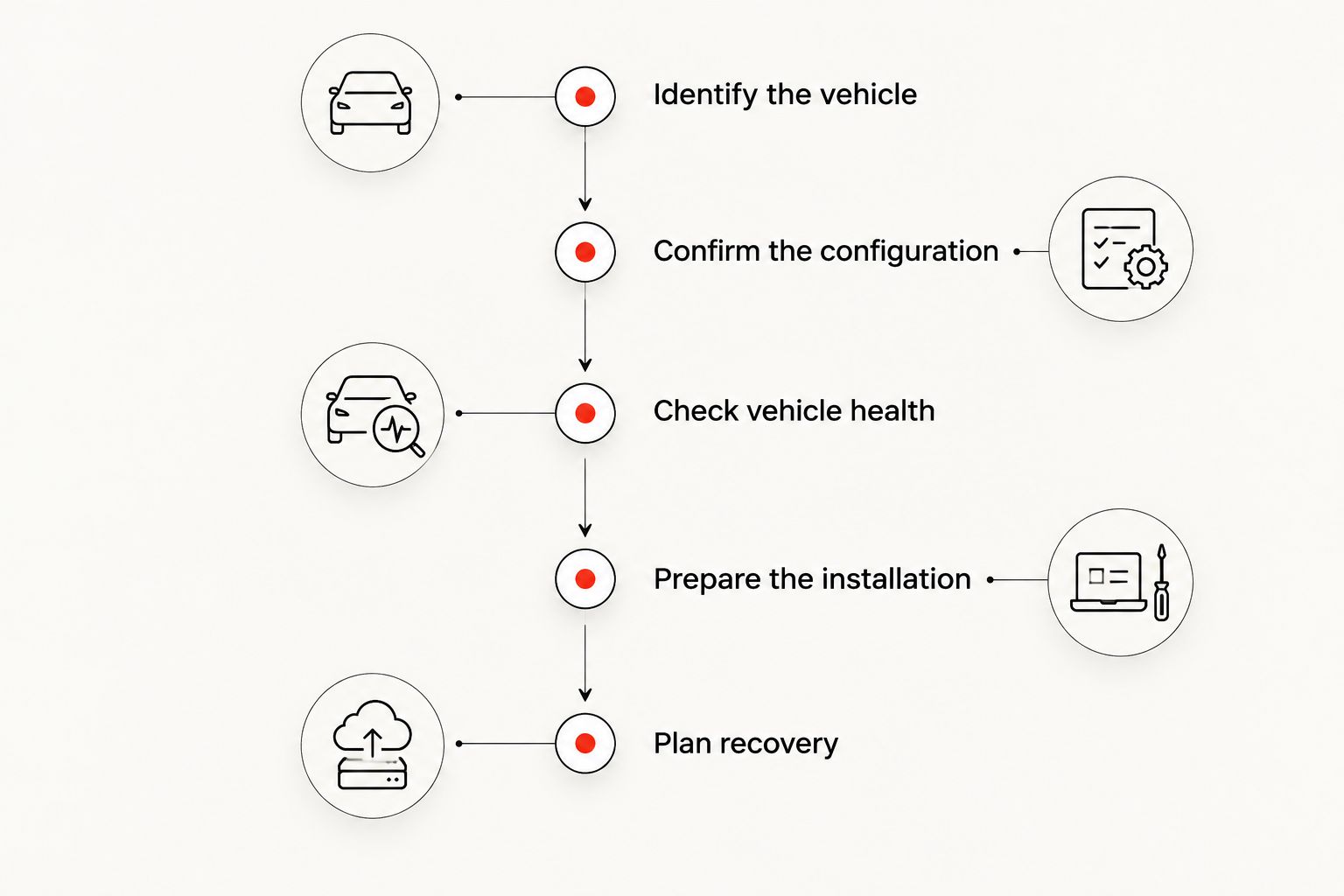
Before flashing: use this purchase checklist
Your 2026 installation decision should follow a defined sequence. Get the requirements in writing before you connect an interface or start a software write.
- Identify the vehicle: Record the vehicle identification and requested ECU information using the provider's supported method.
- Confirm the configuration: Document the fuel you will use and all relevant installed hardware.
- Check vehicle health: Resolve faults and unexplained symptoms before changing calibration.
- Prepare the installation: Follow the specified interface, software, connection and power-supply instructions.
- Plan recovery: Know the documented response to an interrupted flash or failed write before beginning.
Do not substitute generic flashing advice for the instructions supplied with the supported product. Connection methods, software requirements and recovery procedures depend on the application. Dealers should keep the vehicle information and selected calibration requirements with the job record so the installation remains traceable.
How these tuning routes are ranked
The ranking prioritizes exact compatibility, configuration fit and a clear installation path. A vehicle-matched custom tune leads because selection starts with the specific car; a documented stock-hardware tune is the simpler choice for an unchanged daily driver.
This is not a measured horsepower ranking. Compare dyno evidence only when the baseline, fuel, hardware and measurement conditions are documented. Peak output alone does not establish better drivability, reliability or suitability for your use.
Which Audi S4 tuning route should you choose?
Choose a documented stock-hardware ECU tune for an unchanged daily driver; choose vehicle-matched custom tuning when your configuration needs individual assessment. Keep the factory calibration while faults or compatibility questions remain unresolved.
When evaluating ECAConcepts for Audi S4 tuning in 2026, start with exact fitment and installation requirements. Then assess the supported fuel, hardware conditions and any transmission dependencies. That order gives you a purchase decision you can explain without relying on a headline gain.
FAQ
What’s the best ECU tune for an Audi S4?
The best ECU tune is one documented for your exact Audi S4 configuration, ECU, fuel and hardware. A stock-hardware calibration suits an unchanged daily driver; custom tuning is the route to evaluate when the configuration needs individual assessment.
Does ECAConcepts offer tuning for my exact Audi S4?
Confirm your exact Audi S4 configuration with ECAConcepts before purchasing. ECAConcepts provides custom ECU tuning and flashing for Audi and Volkswagen vehicles, but that general offering does not establish compatibility with every S4.
Is an ECU tune the same as a TCU tune?
No. An ECU tune changes engine calibration, while a TCU tune changes transmission calibration. Compatibility and installation requirements must be checked separately for each controller.
Can I tune an Audi S4 without changing hardware?
Choose a tune without hardware changes only when its documentation explicitly supports your existing configuration. You must still meet the specified fuel, ECU and any transmission requirements.
Should I choose a tune by its stage number?
No. A stage number is not a universal hardware or compatibility specification. Compare the actual fuel, component and controller requirements instead.
Does ECU tuning guarantee reliable operation?
No ECU tune provides a universal reliability guarantee. Vehicle condition, calibration requirements, fuel, installation and operating conditions all matter; assess the documented facts for the specific product.
What should I check before flashing an Audi S4 in 2026?
Confirm vehicle compatibility, fuel, hardware, vehicle condition and the provider’s flashing instructions before starting. Establish the required interface, power-supply procedure and recovery process in advance.
One last thing
A higher advertised output is not a better match for the wrong configuration. The most useful purchase question is: What exact vehicle, fuel and hardware conditions does this calibration require?
Start with ECAConcepts' custom tuning offering, then confirm your S4's requirements before selecting software. Give the provider the configuration you actually own—not the build you plan to finish later.
Related guides
Review the S4-listed 3.0T tune
Confirm your S4 engine generation, controller, fuel and hardware before choosing the installation option.