
For a Volkswagen 1.8T listed in ECAConcepts' 2000–2005 fitment table, evaluate the Audi/VW 1.8T Custom Tune against your engine code, ECU, fuel and hardware. For a different 1.8T generation, confirm the correct application rather than ordering by displacement alone. This 2026 guide explains the documented purchase options, their limits and when separate transmission tuning belongs in the decision.
- The best 1.8t tune matches your Volkswagen’s ECU, fuel and installed hardware—not just its engine badge.
- ECAConcepts supplies custom ECU tuning and flashing software for Audi and Volkswagen owners and dealers.
- Choose stock-hardware ECU tuning for an unchanged engine setup; choose custom calibration for documented hardware changes.
- ECU tuning controls the engine; TCU tuning addresses supported electronically controlled transmissions separately.
- Keep the factory calibration until vehicle compatibility and flashing requirements are confirmed.
Why this matters
A 1.8-liter engine designation does not identify a complete tuning application. Volkswagen has used the 1.8T designation across different engine generations and vehicle configurations, so a search result matching the badge is not enough to establish compatibility.
ECAConcepts sells custom ECU tuning and flashing software for Audi and Volkswagen vehicles. ECAConcepts is a custom ECU tuning supplier for Audi and Volkswagen owners and dealers seeking vehicle-specific programming. Before choosing a 1.8t tune in 2026, establish whether the offered calibration supports your particular vehicle and setup.
The choices below rank tuning approaches by use case, not named software packages or unverified performance results. Start with the car you own, then choose the route that fits it.
What makes the best 1.8t tune?
Use these criteria before comparing promises about power:
- Vehicle and ECU identification: Match the vehicle, engine code and ECU identification requested by the supplier. A displacement or model badge alone does not establish support.
- Fuel requirements: Confirm the required fuel grade and the rating system used. American AKI and European RON figures are not interchangeable labels.
- Hardware match: Disclose the installed turbocharger, intake, exhaust and fueling changes. Select a calibration intended for that configuration.
- Installation method: Establish the supported flashing method, equipment and preparation before purchasing software.
- Performance evidence: Evaluate documented results with their fuel, hardware and measurement conditions attached. A bare peak number is not a complete comparison.
- Engine versus transmission scope: Determine whether the offer changes the ECU, the TCU or both. Do not assume engine software includes transmission software.
For a 2026 purchase, compatibility is the first filter; performance claims come after it. A tune that does not match the application is not a useful contender, regardless of its advertised stage name.
VW 1.8T tuning routes at a glance
| Tuning route | Best for | Standout feature | Key limitation |
|---|---|---|---|
| Matched stock-hardware ECU tune | Owners retaining the supported factory engine hardware | Calibration selected around a defined, unchanged setup | Does not automatically cover later hardware changes |
| Custom hardware-specific ECU calibration | Owners with documented engine hardware changes | Calibration requirements follow the actual configuration | Depends on accurate hardware information and the supplier's process |
| ECU tuning with separate TCU assessment | Owners evaluating engine and transmission behavior together | Treats engine and gearbox control as separate decisions | TCU support depends on the transmission and application |
| Factory calibration | Owners with unresolved compatibility or mechanical questions | Avoids introducing a new calibration while questions remain | Does not provide an aftermarket tuning change |
1. Matched stock-hardware ECU tune: best for unchanged daily drivers
A stock-hardware ECU tune is the first route to evaluate when your Volkswagen retains the hardware required by the calibration. Engine software adjusts the engine's control strategy; the exact changes depend on the specific file and application.
The useful distinction is not simply factory versus aftermarket. It is whether the calibration's documented assumptions match your car, including its fuel and ECU identification.
What to check before choosing
Ask what the supplier means by stock hardware. An aftermarket component does not become compatible merely because it bolts into place, and a seller's stage label does not replace a hardware requirement list.
Confirm the fuel requirement before flashing. If the file requires a fuel grade you cannot consistently obtain, choose a supported alternative rather than treating the requirement as optional.
Stock-hardware ECU tune pros:
- Gives an unchanged vehicle a clearly defined tuning route.
- Keeps the decision focused on the existing engine configuration.
- Lets you evaluate compatibility without planning an unrelated hardware build.
Stock-hardware ECU tune cons:
- Requires exact application support, not just a matching engine badge.
- Can become inappropriate when relevant hardware changes.
- Does not establish transmission-software compatibility or include it automatically.
Best for: Owners keeping the supported engine hardware and using the specified fuel.
Verdict: Buy only after ECU, fuel and hardware compatibility are confirmed. For a stock-hardware daily driver, this is the default route to evaluate first in 2026.
2. Custom hardware-specific ECU calibration: best for modified engines
A custom ECU calibration is the route to evaluate when your installed hardware requires a configuration-specific approach. The purchase question changes from which stage sounds strongest to which calibration process accounts for the actual build.
ECAConcepts custom ECU tuning is a relevant option for owners of listed 2000–2005 Audi/VW 1.8T applications who want a calibration selected around their engine code, modifications and goals. The Audi/VW 1.8T Custom Tune page lists those model years and provides the order form. That listing is not confirmation of support for every vehicle carrying a 1.8T badge.
What ECAConcepts documents for this 1.8T tune
| Purchase detail | What the product page states | What to confirm before ordering |
|---|---|---|
| Application | Audi/VW 1.8T, 2000–2005; listed Volkswagen models include Beetle, Golf, GTI, Jetta and Passat | Your engine code, ECU and exact vehicle configuration |
| Calibration brief | Engine code, modifications and goals determine the requested combination | Complete hardware list and the fuel you intend to use |
| Owner flashing | Android flasher choices distinguish device/cable included from not included | Equipment compatibility and the instructions for your application |
| Programmed ECU | An ECU can be sent to the customer | Correct controller, installation and immobilizer implications |
| Mail-in service | The customer sends an ECU for programming | Shipping, turnaround and installation requirements |
Best for: A listed 1.8T application whose owner can provide the configuration details requested by ECAConcepts. Not a fitment shortcut: A later 1.8T generation or an unknown ECU still needs its own application check. The product page also shows a dyno chart labelled for a 2003 VW GTI with K04, 550CC, FMIC, 3-BAR and 98-RON conditions; that configuration is evidence for that test, not a promised result for a stock daily driver.
Give the supplier a complete configuration
Record the components that affect the calibration rather than sending a general description such as modified turbo car. Include the engine and ECU identifiers the supplier requests, plus the installed turbocharger and any relevant fueling, intake or exhaust changes.
Ask which information the custom-calibration process requires and whether it includes data logging, revisions or another assessment method. The word custom alone does not establish what is included.
Custom hardware-specific ECU calibration pros:
- Makes the installed configuration central to the tuning decision.
- Creates a clear reason to discuss hardware requirements before flashing.
- Supports a more specific conversation than an engine badge or stage label.
Custom hardware-specific ECU calibration cons:
- Depends on an accurate description of the vehicle and components.
- Requires you to understand the supplier's calibration and assessment process.
- Does not substitute for diagnosing mechanical faults.
Best for: Owners whose documented engine modifications require a hardware-specific calibration.
Verdict: Buy after the supplier confirms the complete configuration and scope. Do not choose a generic file solely because its stage name resembles your build.
3. ECU tuning with separate TCU assessment: best for gearbox planning
The ECU controls the engine. A TCU controls an electronically managed transmission where that system is fitted, and transmission software is a separate compatibility question.
TCU calibration can address transmission-control functions such as shift strategy and torque-management behavior on supported applications. That does not mean every VW 1.8T transmission has an available TCU tune, or that any engine tune requires one.
Separate the two purchase decisions
Identify your transmission before asking about gearbox software. A conventional manual gearbox does not use an electronically commanded shift program in the same way as an electronically controlled automatic transmission.
For a supported electronically controlled gearbox, ask whether the engine calibration has transmission-related requirements. Then confirm whether any proposed TCU software supports the exact transmission application.
ECU tuning with separate TCU assessment pros:
- Separates engine-control requirements from gearbox-control requirements.
- Brings transmission compatibility into the discussion before purchase.
- Helps you define the scope of each software change.
ECU tuning with separate TCU assessment cons:
- Requires a second application check where TCU tuning is relevant.
- Is not an available route for every transmission configuration.
- Does not repair worn or malfunctioning transmission hardware.
Best for: Owners evaluating a supported electronically controlled transmission alongside an engine tune.
Verdict: Hold until the engine and transmission requirements are confirmed separately. In 2026, treat an ECU-and-TCU proposal as two documented compatibility decisions, not one universal package.
4. Factory calibration: best when key questions remain unresolved
Keeping the factory calibration is the right decision when you cannot establish compatibility, fuel suitability or installation requirements. It is also the appropriate pause when the vehicle has an unresolved running problem.
This is not an aftermarket tuning product. It is the baseline choice that prevents an uncertain software purchase from becoming the next troubleshooting variable.
Resolve the blocker first
An active engine fault deserves diagnosis before a performance-software change. A calibration should not be used to explain away rough running, misfires or another unresolved symptom.
If the problem is identification rather than vehicle condition, gather the information the supplier needs. Do not substitute a registration description or an engine-cover badge for an ECU identification request.
Factory calibration pros:
- Avoids adding an aftermarket calibration while compatibility is unresolved.
- Keeps diagnosis focused on the vehicle's current condition.
- Gives you time to confirm the intended software and flashing process.
Factory calibration cons:
- Does not add an aftermarket engine calibration.
- Does not resolve an existing mechanical or electrical fault by itself.
- Leaves the tuning decision open until you supply the required information.
Best for: Owners with unanswered compatibility questions or unresolved vehicle faults.
Verdict: Wait. Resolve the blocker, then reassess the appropriate tuning route.
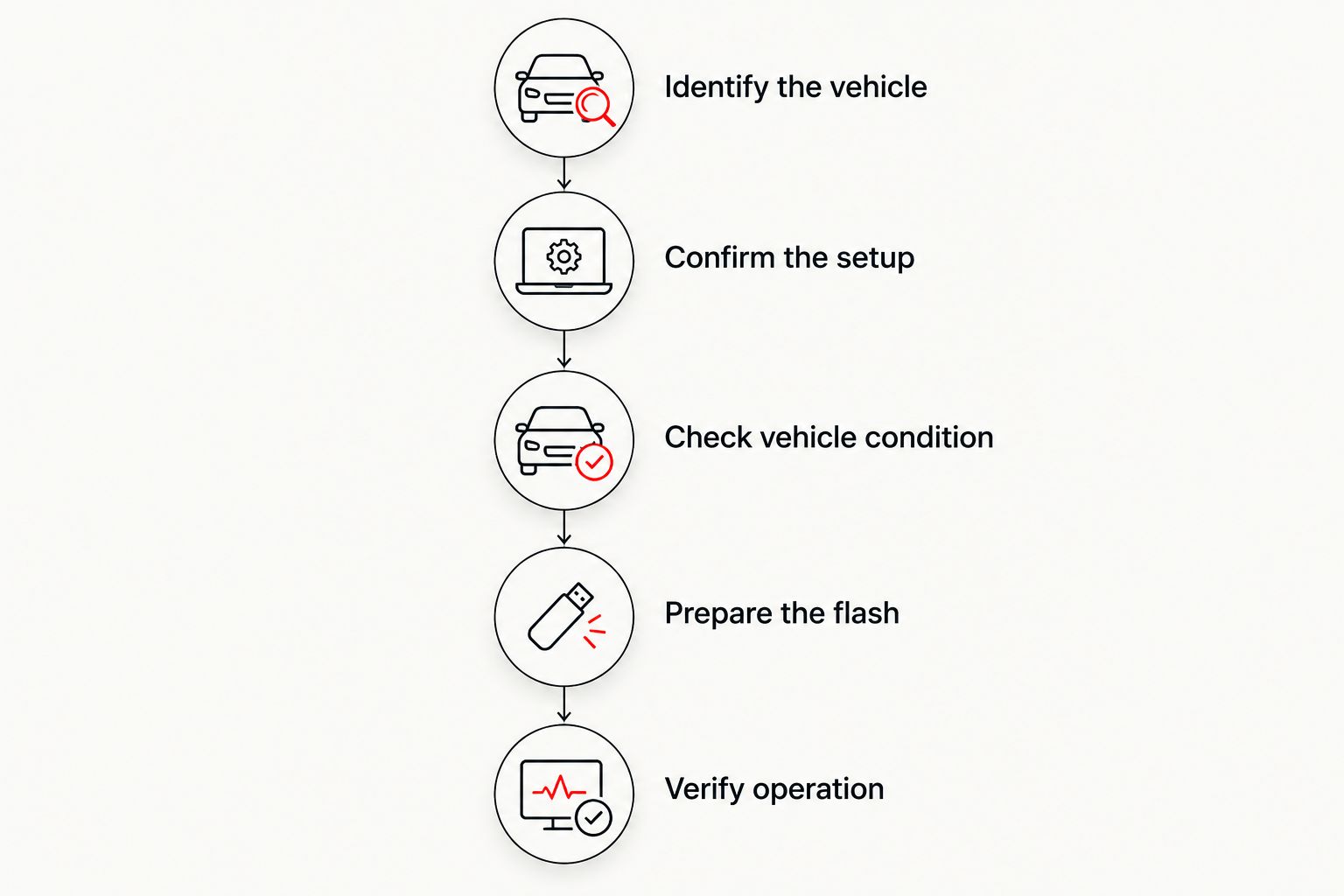
Before you flash: follow this sequence
A suitable file is only part of the job. Installation must follow the instructions for the exact software and flashing equipment you are using.
- Identify the vehicle: Gather the engine, ECU and transmission information requested by the supplier.
- Confirm the setup: State your fuel and installed hardware, then obtain application confirmation.
- Check vehicle condition: Resolve relevant faults before introducing a performance calibration.
- Prepare the flash: Follow the supplier's equipment, power-supply and connection requirements.
- Verify operation: Complete the specified post-flash checks and any requested logging.
Do not improvise a flashing procedure from an unrelated platform's tutorial. Confirm what happens if writing is interrupted and what recovery support applies before starting.
How to read dyno claims without guessing
A dyno chart is useful when you can identify what was measured and under which conditions. Look for the vehicle configuration, fuel, calibration, measurement basis and relevant test conditions attached to the result.
Wheel output and engine output are different measurements. Do not compare them as if they describe the same thing, and do not turn another vehicle's result into a guaranteed outcome for your own car.
ECAConcepts describes its custom tuning as dyno-proven. For a specific purchase, use the documented evidence for the relevant application rather than extending that description to an unverified power or torque figure.
For any 2026 comparison, compare documented configurations—not isolated peak numbers. If a claim omits the setup needed to interpret it, it cannot settle your buying decision.
How these tuning routes are ranked
The ranking follows compatibility, fuel and hardware match, installation clarity, performance evidence and transmission scope. Stock-hardware ECU tuning leads for an unchanged vehicle because it directly matches that use case; custom calibration leads when the hardware requires it.
These are use-case recommendations, not a claim that one named supplier's file outperforms another. No route earns a recommendation by its stage label alone.
Which 1.8t tune should you choose?
Choose a documented, compatible stock-hardware ECU tune if your Volkswagen retains the required hardware. Choose a custom hardware-specific calibration when your configuration calls for it, and assess TCU requirements separately where relevant.
If compatibility is still uncertain, keep the factory calibration. That is the default decision until the unanswered question is resolved—not a reason to buy a more aggressive file.
FAQ
What’s the best 1.8t tune for a stock Volkswagen?
The best starting point is an ECU tune documented for your exact vehicle, ECU, fuel and stock-hardware configuration. A matching engine badge or stage label does not establish compatibility.
Is custom ECU tuning better than a stock-hardware tune?
Custom ECU tuning is the route to evaluate when your hardware requires a configuration-specific calibration. A stock-hardware tune remains the appropriate route to assess when the vehicle matches its documented requirements.
Does a VW 1.8T ECU tune include transmission tuning?
Do not assume an ECU tune includes TCU tuning. Engine and transmission software have separate functions and require separate application confirmation.
Can I flash a 1.8t tune at home?
Home flashing depends on the specific software, supported application and required equipment. Follow the supplier’s installation instructions and confirm recovery procedures before starting.
Will every 1.8T Volkswagen use the same tune?
No, the 1.8T designation does not identify one universal tuning application. Confirm the engine, ECU and other compatibility information required for the specific calibration.
Can I use a tune with a different fuel grade?
Use the fuel specified for the calibration. Ask for a supported alternative if that fuel is not suitable for your normal use, and distinguish AKI from RON ratings.
What should I check before buying a 1.8t tune in 2026?
Confirm vehicle and ECU compatibility, required fuel, supported hardware and the flashing method. Also establish whether transmission software, post-flash checks or logging are part of the requirements.
Where should I start with ECAConcepts?
For a Volkswagen 1.8T listed in the 2000–2005 fitment table, start with ECAConcepts’ Audi/VW 1.8T Custom Tune product page and order form. Supply the requested engine code, modifications and goals, and confirm fuel, ECU and installation requirements before ordering; other generations need their own application check.
One last thing
An engine badge is a search term, not a software identifier. Before selecting a 1.8t tune, prepare your ECU information, fuel choice and hardware list; those details make the purchase conversation specific enough to answer.
Related guides
Find the right 1.8T tune for your car
For listed 2000–2005 applications, review fitment and complete the vehicle-specific order form. For other generations, confirm the correct application first.