
Best overall: an ECU-matched calibration with documented fuel and hardware requirements. Best for an unmodified GTI: a verified stock-hardware tune. Best for a modified GTI: a configuration-specific custom tune. Best for avoiding tuning-related changes: factory software. This 2026 MK7 GTI tune guide ranks those paths by fit, installation requirements and the evidence you need before flashing.
- The best MK7 GTI tune matches your ECU, fuel and installed hardware—not just your model badge.
- ECAConcepts offers custom ECU tuning; confirm exact MK7 GTI support before choosing a calibration.
- ECU tuning changes engine control; TCU tuning changes transmission control. They are separate purchase decisions.
- Keep factory software until compatibility, flashing requirements and recovery instructions are clear.
Why this matters
A tuning label does not identify everything your car needs. Two listings described as suitable for a GTI can differ in supported ECU software, required fuel, hardware assumptions and installation method.
ECAConcepts sells custom ECU tuning and flashing software for Audi and Volkswagen vehicles. For a MK7 GTI purchase, verify the exact application rather than treating broad Volkswagen coverage as confirmation of compatibility.
The strongest recommendation is the tune whose requirements you can verify against your actual car. A power claim without matching test conditions does not answer that question.
What makes the best MK7 GTI tune?
Use these criteria before comparing names or advertised results. Your 2026 shortlist should pass every compatibility check before performance becomes the deciding factor.
- ECU support: Confirm the ECU identification and software version accepted by the specific calibration and flashing method.
- Fuel requirements: Match the calibration to the fuel grade and fuel type you will actually use. Clarify the octane rating convention.
- Hardware fit: Check required and excluded modifications, including changes that affect airflow, fueling or exhaust configuration.
- Installation clarity: Establish the flashing equipment, software, power supply and connection requirements before starting.
- Evidence and support: Look for documented test conditions, logging instructions and a clear procedure for an interrupted flash or an unsuccessful installation.
- Transmission planning: Separate engine calibration from transmission calibration, and establish whether any additional transmission work is required for the selected configuration.
A missing answer is a reason to pause the purchase. It is not a detail to resolve halfway through a flash.
MK7 GTI tuning paths at a glance
These are buying paths, not a ranking of unsupported product claims. Each serves a different vehicle configuration or ownership priority.
| Tuning path | Best for | Standout feature | Key limitation |
|---|---|---|---|
| ECU-matched calibration | Buyers choosing their first tune | Starts with exact controller and software identification | Requires confirmation beyond the model name |
| Verified stock-hardware tune | Owners retaining the original engine hardware configuration | Defines a calibration around documented stock-hardware requirements | Does not establish suitability for later modifications |
| Configuration-specific custom tune | Owners with a modified engine setup | Addresses a stated combination of hardware and fuel | Requires accurate configuration details and a defined validation process |
| Factory software | Owners prioritizing an unchanged calibration | Avoids installing an aftermarket engine calibration | Does not provide an aftermarket tuning change |
The distinction matters: an ECU-matched calibration is the default selection method. Stock-hardware and custom tuning are narrower choices within that method. Factory software is the alternative when the purchase cannot yet be justified.
1. ECU-matched calibration: best for first-time tune buyers
An ECU-matched calibration starts with the controller in your car, not a broad fitment label. The provider confirms that the engine software and flashing method support that particular ECU identification.
This is the best default buying path in 2026 because it addresses compatibility before you commit to a performance target. It does not mean every calibration sold under a MK7 GTI label supports every controller or software revision.
ECU-matched calibration pros
- Makes controller compatibility the first purchase condition.
- Creates a clear starting point for checking fuel and hardware requirements.
- Helps separate a supported application from a general model listing.
- Gives a dealer a specific configuration to verify before scheduling work.
ECU-matched calibration cons
- Requires ECU information rather than only a vehicle description.
- Does not establish fuel or hardware compatibility by itself.
- Does not prove any advertised performance result applies to your car.
Best for: A first-time buyer who wants a documented fit before choosing a tuning level.
Ask what information the provider needs and how to obtain it. Do not substitute a registration year or an engine badge for the requested controller details. Also confirm whether the current software matters if the car has received a manufacturer update or a previous tune.
Verdict: Buy only after ECU, fuel, hardware and installation support are confirmed.
2. Verified stock-hardware tune: best for an unmodified GTI
A stock-hardware tune is intended for the hardware configuration the provider explicitly identifies. The label is useful only when its requirements explain what counts as stock and which existing changes are acceptable.
A listing described as Stage 1 does not replace those requirements. Treat the stage name as a label, then read the actual fitment and installation conditions.
Verified stock-hardware tune pros
- Provides a focused buying path for owners retaining original engine hardware.
- Makes it easier to compare requirements without mixing unrelated upgrade packages.
- Lets you evaluate the calibration separately from a planned hardware project.
- Establishes a baseline configuration for later purchase discussions.
Verified stock-hardware tune cons
- Existing modifications can put the car outside the stated configuration.
- Future hardware changes require a fresh compatibility check.
- A stage label alone does not identify supported fuel or transmission requirements.
Best for: An owner whose car matches the documented stock-hardware configuration and who is not buying around a larger modification plan.
Give the provider a complete modification list, including changes made by a previous owner. If you do not know whether the car already has aftermarket software, resolve that before selecting another file.
For a 2026 purchase, ask whether the exact calibration requires any supporting work. Do not assume that stock-hardware compatibility also means every installation tool, transmission arrangement or fuel choice is covered.
Verdict: Buy when the documented configuration matches the car; hold if its modification history is unclear.
3. Configuration-specific custom tune: best for a modified GTI
A configuration-specific custom tune addresses an identified combination of engine hardware, fuel and ECU software. Its value depends on how clearly that combination is defined and how the calibration is checked.
ECAConcepts' Audi/VW 2.0T Custom Tune (2016+) page lists Volkswagen GTI 2.0T model years 2015–2023 in its fitment table. ECAConcepts custom ECU tuning is a relevant option for a listed GTI application when the controller, fuel and installed hardware match the confirmed calibration requirements. Supply your Controller ID and modification list before choosing a file; the model-year range alone is not an ECU compatibility check.
| Buyer question | What ECAConcepts documents | What still needs confirmation |
|---|---|---|
| Which GTI years are listed? | GTI 2.0T, 2015–2023, on this product page | Exact ECU and software support |
| What defines the requested tune? | Controller ID, modifications and goals | Fuel, hardware and validation requirements |
| What owner-flashing choice appears in the order form? | Windows software with a Flash Tool included, plus a previous-customer option | The correct equipment and installation method for your car |
The page's general installation headings and its order-form choices are not identical. Confirm the method for your GTI rather than assuming that every listed flashing option applies to every controller.
Configuration-specific custom tune pros
- Puts the actual modification list at the center of the purchase.
- Provides a way to discuss a setup that does not match a standard configuration.
- Makes fuel selection part of the calibration brief.
- Creates a basis for asking how logs and revisions are handled.
Configuration-specific custom tune cons
- Depends on complete and accurate hardware information.
- Requires a clearly defined validation process, not just the word custom.
- Later changes to fuel or hardware require another compatibility discussion.
Best for: An owner with a modified setup that needs explicit calibration support rather than assumptions based on a stage name.
Ask whether data logging is required, who evaluates the logs and what happens if the results identify a mechanical issue. Establish the revision process before purchasing; do not infer it from the service description.
A dyno-proven claim is useful when its documented conditions match the comparison you are making. Ask for the tested vehicle configuration, fuel, measurement basis and baseline. Do not apply one vehicle's result to a different setup.
Verdict: Buy after the provider accepts your exact configuration and explains its validation process.
4. Factory software: best for keeping the calibration unchanged
Factory software is the right reference point when you are not ready to install an aftermarket calibration. Keeping the existing factory calibration lets you resolve vehicle condition, ownership priorities and compatibility questions before committing to tuning.
That recommendation is not a claim that an older car still has its original software. Establish its current calibration history first.
Factory software pros
- Avoids introducing an aftermarket engine calibration.
- Gives you time to resolve unknown modifications or software history.
- Keeps hardware and tuning purchases separate while you plan the car.
Factory software cons
- Does not deliver an aftermarket calibration change.
- Does not correct mechanical faults or neglected maintenance.
- Returning a previously tuned car to factory software requires its own verified procedure.
Best for: An owner with unresolved vehicle issues, uncertain software history or no clear reason to change the calibration.
In 2026, waiting is a practical decision when the necessary answers are missing. A tune should follow a defined plan, not substitute for diagnosis.
Verdict: Wait on aftermarket tuning until the vehicle and purchase requirements are understood.
ECU tuning and TCU tuning are different purchases
ECU tuning changes engine-control calibration. TCU tuning changes transmission-control calibration on a supported electronically controlled transmission. One does not establish compatibility for the other.
For a manual-transmission car, discuss clutch condition and the selected engine calibration's requirements. For a car with an electronically controlled automatic transmission, ask whether the chosen ECU tune requires or recommends a separate TCU calibration. Get an application-specific answer.
| Decision | ECU tuning | TCU tuning |
|---|---|---|
| Control system | Engine controller | Transmission controller |
| Purchase question | Does the engine calibration match the ECU, fuel and hardware? | Does the transmission calibration support the exact transmission controller? |
| Main benefit to evaluate | Documented engine-calibration changes | Documented transmission-calibration changes |
| Main limitation | Does not establish transmission support | Does not establish engine-calibration support |
Best for ECU tuning: Owners evaluating an engine-calibration change. Best for TCU tuning: Owners with a supported transmission and a documented reason to change its calibration. Neither is an automatic substitute for the other.
What to confirm before flashing
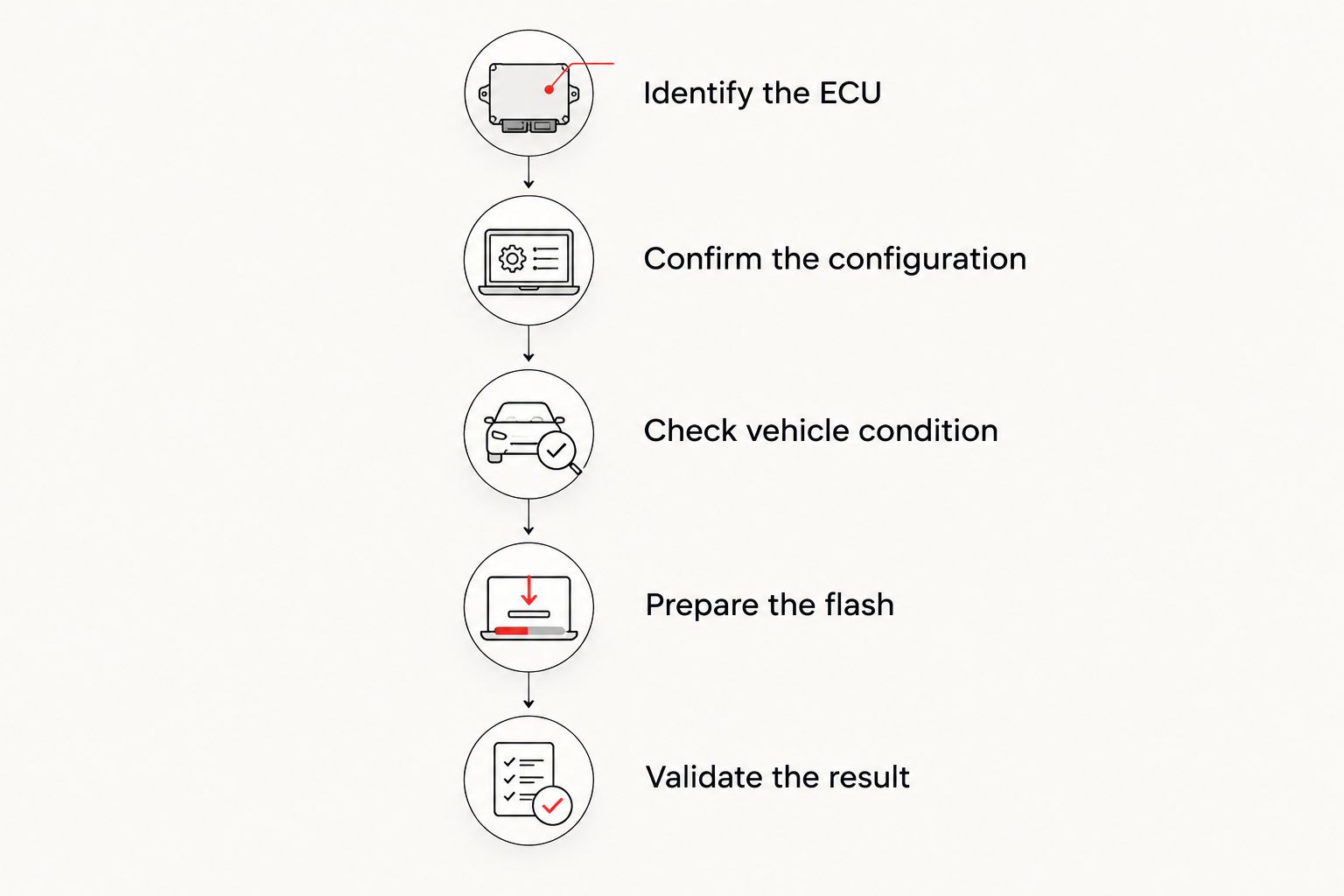
Use this sequence to turn a promising listing into a defined installation plan. Keep the provider's instructions with the vehicle information rather than relying on a generic flashing guide.
- Identify the ECU. Record the controller information and current software details requested by the provider.
- Confirm the configuration. Supply the transmission type, fuel choice and complete hardware list.
- Check vehicle condition. Resolve warning lights, fault codes and known running problems before changing the calibration.
- Prepare the flash. Follow the specified equipment, connection and power-supply instructions.
- Validate the result. Complete the prescribed checks or logging before treating the installation as finished.
Do not assume every product uses the same installation method. Confirm whether the purchase involves owner-operated flashing, dealer installation or another specified procedure. Ask what to do if the process stops, and keep those instructions accessible before starting.
How these tuning paths are ranked
This 2026 ranking puts verified compatibility ahead of advertised output. ECU support comes first, followed by fuel and hardware fit, installation clarity, transmission planning and documented evidence.
There is no defensible brand performance leaderboard without comparable application-specific evidence. ECAConcepts belongs in a custom ECU tuning discussion because that service is explicitly offered; exact MK7 GTI suitability remains a product-level decision.
Which MK7 GTI tune should you choose?
Choose an ECU-matched calibration as your default, then select stock-hardware or custom tuning according to the car's verified configuration. Keep factory software if compatibility or vehicle condition remains unresolved.
For an unmodified car, start with documented stock-hardware requirements. For a modified car, submit the configuration before selecting a file. For either car, separate the transmission decision from the engine-calibration purchase.
FAQ
What’s the best MK7 GTI tune in 2026?
The best MK7 GTI tune is a calibration verified for your exact ECU, fuel and installed hardware. Choose a stock-hardware or custom path only after those requirements and the flashing procedure are confirmed.
Does ECAConcepts tune the MK7 GTI?
ECAConcepts offers custom ECU tuning and flashing software for Audi and Volkswagen vehicles; confirm exact MK7 GTI support before purchasing. Broad Volkswagen coverage does not establish support for a particular ECU or software version.
Is a Stage 1 tune right for a stock MK7 GTI?
A Stage 1 label alone does not confirm suitability for a stock MK7 GTI. Check the specific calibration’s ECU, fuel, hardware and transmission requirements.
Do I need a TCU tune with a MK7 GTI ECU tune?
A TCU tune is a separate compatibility decision, not an automatic requirement for every ECU tune. Ask whether the selected engine calibration requires or recommends transmission changes for your exact setup.
Can I flash a MK7 GTI tune at home?
Home flashing depends on the specific product’s supported installation method. Confirm the required equipment, software, power supply and recovery instructions before starting.
How much power will a MK7 GTI tune add?
Use documented results for the exact calibration and stated test configuration rather than a generic power estimate. Check the fuel, hardware, baseline and measurement basis before comparing claims.
Can I use a different fuel after tuning my GTI?
Use only fuel that meets the selected calibration’s documented requirements. Confirm any intended fuel change with the provider rather than assuming the existing file supports it.
Is a MK7 GTI tune emissions legal?
Emissions legality requires application-specific documentation and the rules that apply where the car is used. Do not treat a tuning label or a general product description as proof of legal compliance.
One last thing
A calibration file is not the whole purchase. Clear compatibility, installation and recovery instructions are part of choosing the tune. They determine whether you have an actionable plan before the car is connected for flashing.
For your 2026 shortlist, send the ECU details, fuel choice, transmission type and modification list together. Ask ECAConcepts to confirm the relevant application and installation requirements before selecting custom ECU tuning software.
Related guides
Review the GTI tune and confirm your ECU
The 2.0T listing includes GTI 2015–2023. Confirm controller, fuel, hardware and flashing support before ordering.