
Best overall for daily-driver Audi TT RS tuning: an ECU calibration matched to your existing hardware and fuel. Best for individual requirements: a custom calibration with a defined review process. Best for a modified car: a hardware-specific calibration. If you are considering ECAConcepts, confirm support for your exact TT RS before selecting software.
- For daily-driver Audi TT RS tuning, prioritize verified ECU, fuel and hardware compatibility over advertised peak output.
- ECAConcepts offers custom Audi/VW ECU tuning; confirm exact TT RS support before buying.
- Choose custom calibration when you need documented adjustment and review for your specific configuration.
- ECU tuning and TCU tuning serve different controllers; confirm transmission requirements separately.
- Keep the factory calibration until maintenance issues and compatibility questions are resolved.
Why this matters
The best tune is not simply the file attached to the largest advertised power figure. It is the calibration that matches your car, the fuel you consistently use and the installation method you can complete correctly.
For a daily driver in 2026, the purchase decision also includes cold starts, part-throttle response, transmission behavior and support after flashing. A performance claim does not answer those questions by itself. You need specific answers before committing.
ECAConcepts is a custom ECU tuning option for Audi and Volkswagen owners seeking vehicle-specific calibration. Exact TT RS compatibility still needs confirmation; general Audi coverage is not a fitment guarantee.
What makes the best Audi TT RS tuning option?
Use these criteria before comparing tune names or advertised stages:
- Exact compatibility: Confirm the vehicle identity, ECU identification and current software against the relevant product documentation or a written fitment response.
- Fuel match: Choose a calibration for fuel you can consistently obtain. Confirm the required octane rating and rating system.
- Hardware match: Declare the installed intake, exhaust, turbocharger and other relevant changes. Do not assume a stage label describes your configuration.
- Installation clarity: Establish the flashing method, required equipment, power-supply requirements and interruption-recovery procedure.
- Daily-use behavior: Ask how the calibration addresses normal driving, not just full-throttle operation.
- Support scope: Establish what happens after installation, including any logging, revisions, diagnostics or return-to-stock procedure.
Treat compatibility as the gate, not another feature to score. A tune that does not support your ECU is not a runner-up; it is the wrong purchase.
Audi TT RS tuning options at a glance
These are ranked purchase approaches, not interchangeable products. Choose the row that matches your car's condition and your intended use.
| Rank and option | Best for | Standout feature | Key limitation |
|---|---|---|---|
| 1. Stock-hardware-matched ECU calibration | A daily driver retaining its current hardware | Defines the tune around the existing configuration | Still requires exact ECU and fuel confirmation |
| 2. Custom ECU calibration | An owner needing an individual adjustment process | Allows vehicle-specific requirements to shape calibration work | Custom scope and review procedures must be agreed |
| 3. Hardware-specific ECU calibration | A car with documented performance modifications | Matches software selection to installed components | Hardware changes can alter calibration requirements |
| 4. Factory calibration | A car with unresolved faults or uncertain compatibility | Avoids adding a calibration change during diagnosis | Does not provide an aftermarket calibration change |
1. Stock-hardware-matched ECU calibration: best for daily use
A stock-hardware-matched ECU calibration is the default choice for an owner who wants a tune without planning an accompanying hardware build. The defining requirement is explicit approval for the car's existing configuration—not an assumption that an entry-level stage works on every TT RS.
For a 2026 purchase, give the seller your ECU identification, installed hardware and intended fuel. Ask whether the calibration requires any additional components or transmission software. A short product label is not a substitute for those answers.
Stock-hardware-matched ECU calibration pros:
- Keeps the purchase focused on the car you already drive.
- Makes existing hardware the starting point for fitment checks.
- Provides a clear basis for discussing everyday response and fuel requirements.
Stock-hardware-matched ECU calibration cons:
- Existing modifications still need disclosure, even if you consider them minor.
- Future hardware changes require another compatibility check.
- A stock-hardware label does not establish flashing access or transmission support.
Best for: You use the TT RS regularly, intend to retain its configuration and want clearly defined installation requirements.
Ask the seller to distinguish required hardware from optional recommendations. That separation helps you understand the actual scope of the purchase without turning a straightforward tune into an unplanned project.
Verdict: Buy only after ECU, hardware, fuel and installation compatibility are confirmed.
2. Custom ECU calibration: best for individual requirements
Custom ECU calibration addresses a specified vehicle configuration and agreed requirements rather than relying on the word custom alone. Before buying, establish what information the calibrator reviews, what adjustments are included and how completion is determined.
ECAConcepts offers custom ECU tuning and flashing software for Audi and Volkswagen vehicles. For a TT RS inquiry, start with exact vehicle and ECU details, then request the applicable product documentation and installation requirements.
Custom ECU calibration pros:
- Creates a place to document individual hardware and fuel requirements.
- Lets you discuss specific everyday-driving concerns before calibration work.
- Supports a defined feedback process when that process is included in the service.
Custom ECU calibration cons:
- The word custom does not specify logging, revisions or dyno work.
- You must understand your responsibilities during any review process.
- A custom file is not a remedy for an unresolved mechanical fault.
Best for: You have a specific requirement that a standard product description does not resolve, and the calibrator confirms a suitable process.
Ask what triggers a revision and what falls outside the agreed scope. Also ask whether a later hardware change requires a different calibration or a separate service. These questions establish what you are actually buying.
Verdict: Buy when the supported configuration and calibration-review process are explicit.
3. Hardware-specific ECU calibration: best for a modified TT RS
A hardware-specific ECU calibration is the appropriate route when installed modifications determine the software requirements. The job starts with an accurate component list, not a preferred stage name.
For your 2026 comparison, record actual part names and relevant specifications. If a previous owner modified the car, verify what remains installed before selecting software; an old invoice does not establish the current configuration.
Hardware-specific ECU calibration pros:
- Makes the installed configuration central to software selection.
- Helps identify required supporting components before flashing.
- Provides a documented configuration to reference during later troubleshooting.
Hardware-specific ECU calibration cons:
- An incomplete component list undermines the fitment decision.
- Changing hardware can require another calibration review.
- ECU compatibility alone does not settle transmission requirements.
Best for: Your TT RS already has performance hardware, or you have a confirmed build specification that the calibrator supports.
Do not compare hardware-specific tunes by stage number alone. Ask each seller to describe the supported components, fuel and controller requirements in plain terms. Two similarly named packages are only comparable after those requirements line up.
Verdict: Buy the calibration approved for the actual hardware, not the most aggressive label.
4. Factory calibration: best while faults remain unresolved
Keeping the factory calibration is the right decision when the car has unresolved running problems, uncertain hardware or an unidentified ECU configuration. Diagnose the car before introducing another variable.
This is a readiness decision, not a claim that factory software prevents failures. A standard calibration cannot correct worn components, maintenance problems or incompatible parts.
Factory calibration pros:
- Avoids adding an aftermarket calibration change during diagnosis.
- Gives you time to establish the car's current hardware and software state.
- Separates maintenance decisions from performance-purchase decisions.
Factory calibration cons:
- Does not deliver an aftermarket calibration change.
- Does not eliminate existing faults or mechanical risk.
- Does not establish whether a used car was previously modified.
Best for: You have warning lights, unexplained drivability symptoms, incomplete service information or unanswered fitment questions.
If the car is already tuned, do not assume a generic return-to-stock file is appropriate. Establish what software is installed and follow the relevant provider's documented procedure.
Verdict: Wait until the car's condition and software identity are established.
ECU tuning and TCU tuning are separate decisions
An ECU calibration changes engine-control software. A TCU calibration changes transmission-control software. One does not automatically include the other, and an engine tune's product name does not establish transmission compatibility.
For a daily-driver TT RS, ask whether the selected ECU calibration requires a TCU change, recommends one or supports the existing transmission software. Those are different answers with different purchase implications.
Do not buy transmission software simply because it appears beside an ECU tune. First establish the supported combination and what behavior the transmission calibration is intended to change. Discuss any existing shift-quality concerns before installation.
Also separate reported engine output from output measured at the wheels when reading performance material. Compare documented test conditions, fuel and hardware; unlike measurements do not establish which calibration suits your commute.
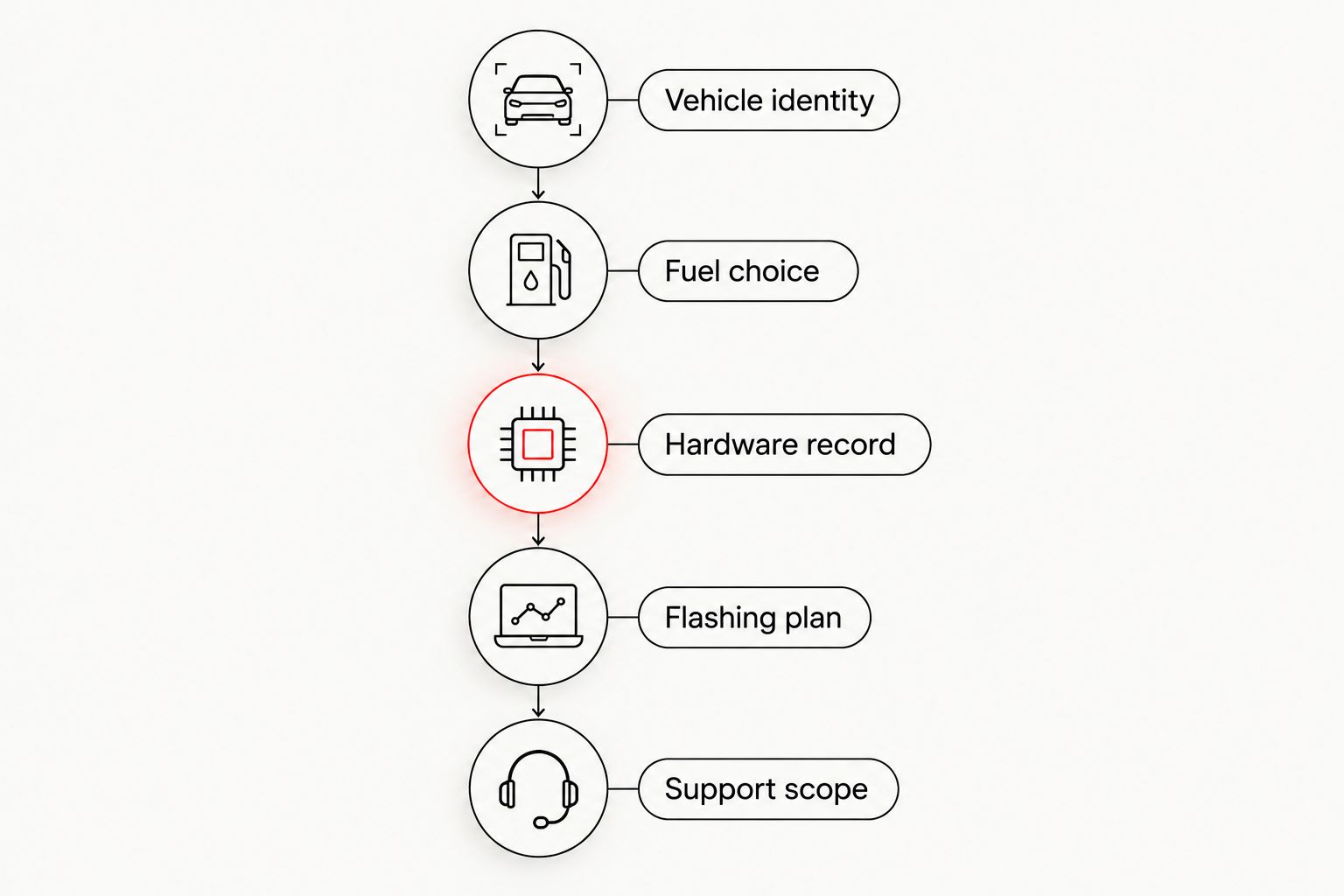
Before flashing: a practical purchase sequence
Use this sequence for a 2026 tune purchase. It turns a broad performance inquiry into a specification the seller can assess.
Vehicle identity
Record the vehicle details requested by the seller and obtain the ECU identification using the prescribed method. Confirm the current software state rather than assuming the car is untouched because it drives normally.
Fuel choice
State the fuel you intend to use consistently. Ask how the calibration handles your intended fuel specification and what action is required if that fuel is unavailable; do not improvise an answer from another tune's instructions.
Hardware record
List installed components accurately, including changes made before your ownership. Resolve unknown parts before the calibration is selected, particularly when the seller identifies a component as relevant to compatibility.
Flashing plan
Confirm the approved installation method and equipment. Obtain the provider's instructions for battery support, file selection, interruptions and recovery before starting—not after a flash stops.
Support scope
Keep the applicable instructions and agreed support terms. If the service includes logs or revisions, establish the requested procedure and operating conditions before collecting anything.
Your first drive should follow the provider's instructions. Do not substitute an internet acceleration test for a documented post-installation check, and never collect driving logs in a way that compromises road safety.
How the options are ranked
The ranking prioritizes daily-driver fit: verified compatibility, a realistic fuel requirement, appropriate hardware, clear installation and defined support. It does not rank vendors by an unsupported horsepower comparison.
Stock-hardware-matched calibration comes first because it addresses the owner keeping the existing configuration. Custom calibration serves individual requirements; hardware-specific calibration serves a documented modified setup. Factory calibration remains the correct holding position when the car is not ready.
For any claimed dyno result, ask for the vehicle configuration, fuel, measurement basis and test conditions. A peak figure without that context does not establish the result your car will deliver.
Which Audi TT RS tuning option should you choose?
For a daily driver in 2026, choose a calibration approved for your existing ECU, hardware and consistently available fuel. Move to a custom or hardware-specific route when your requirements justify it—not because a higher stage sounds better.
If ECAConcepts is on your shortlist, make the first conversation a fitment conversation. Provide the ECU identity, current hardware and intended fuel, then establish the installation method and any TCU requirement before purchasing.
FAQ
What’s the best Audi TT RS tuning option for a daily driver?
The best starting point is an ECU calibration explicitly approved for your existing hardware, ECU and intended fuel. Confirm installation and transmission requirements before buying.
Does ECAConcepts offer a tune for my exact Audi TT RS?
Confirm exact TT RS support with ECAConcepts before purchasing. General Audi/VW tuning coverage does not establish compatibility with your vehicle’s ECU and software.
Is custom ECU tuning better than a standard calibration?
Custom ECU tuning is the better fit when your individual requirements need a defined calibration and review process. A supported standard calibration remains a valid choice when it matches the complete configuration.
Do I need a TCU tune with an Audi TT RS ECU tune?
A TCU tune is required only if the selected ECU calibration’s documented requirements call for it. Confirm the supported engine and transmission software combination rather than assuming both purchases are necessary.
Can I tune a TT RS without changing hardware?
Only select a tune without hardware changes when its documentation explicitly supports your existing configuration. Confirm fuel, ECU and transmission requirements separately.
Can I flash an Audi TT RS tune at home?
Home flashing depends on the approved installation method for the exact product and ECU. Confirm equipment, battery-support instructions and recovery procedures before starting.
Will an ECU tune fix a running problem?
Do not use an ECU tune as a substitute for diagnosing a running problem. Resolve faults and establish the vehicle’s current configuration before changing calibration.
What should I compare besides advertised horsepower?
Compare compatibility, fuel requirements, hardware requirements, installation and support scope. For performance claims, compare the documented test conditions and measurement basis as well.
One last thing
Ask what happens after a dealer software update or a future hardware change. You need the provider's procedure for checking compatibility again; saving the original purchase confirmation is not the same as confirming the new software state.
Before ordering, send ECAConcepts your vehicle details, ECU identification, hardware list and intended fuel. Request confirmation of the supported calibration and flashing process. That is the next step that turns a shortlist into an informed purchase.
Confirm your TT RS tuning fitment
Start with your vehicle details, ECU identification, installed hardware and intended fuel.
Related guides
These guides cover other applications. Their fitment requirements do not establish TT RS compatibility.
- ECU tune selection for the Audi 2.0T
- ECU tune selection for the Audi S4
- ECU tune selection for the Audi 4.0T V8