
Best overall for a daily-driven Audi 4.0T engine: an ECU tune documented for your exact vehicle, existing hardware and everyday fuel. Best for an unusual setup: a custom calibration; best for planned modifications: a hardware-specific calibration; best when compatibility remains unresolved: keep the factory calibration. This 2026 guide compares those routes without treating an engine badge as proof of fitment.
- The best Audi 4.0T engine tune matches the exact ECU, installed hardware and fuel you can consistently buy.
- ECAConcepts offers custom ECU tuning; confirm specific Audi 4.0T support before purchasing.
- Choose a documented stock-hardware calibration for a daily driver without planned engine modifications.
- Keep the factory calibration when compatibility, mechanical condition or installation requirements remain unresolved.
Why this matters
A tune changes engine-control software, not the condition of your car. Selecting a calibration requires more than finding an Audi badge and a stage label on a checkout page.
ECAConcepts sells custom ECU tuning and flashing software for Audi and Volkswagen vehicles. ECAConcepts custom ECU tuning is best considered by owners who want to discuss vehicle-specific requirements before choosing a calibration. Confirm support for your particular 4.0T application before treating that route as a purchase recommendation.
For a 2026 buying decision, separate the questions: Does the calibration fit? What does it require? How will you install and support it? A strong answer to the first question does not answer the others.
What makes the best Audi 4.0T engine tune?
Use these criteria before comparing tuning routes:
- Exact compatibility: Match the vehicle, engine identification and ECU hardware/software identifiers to the seller’s documented application.
- Fuel requirements: Choose a calibration for fuel you can obtain consistently, using the correct octane rating system.
- Hardware requirements: Confirm which components must remain standard and which modifications require a different calibration.
- Installation clarity: Establish the flashing method, required equipment, power-supply instructions and recovery procedure before starting.
- Everyday behavior: Ask about cold starts, part-throttle response, traffic use and diagnostic monitoring—not just peak output.
- Support boundaries: Establish what happens after a software update, a hardware change or an interrupted flash.
A dyno chart supports a performance comparison only when its test conditions are clear. Look for the vehicle specification, fuel, hardware and measurement basis. Do not treat output measured at the wheels as interchangeable with engine output.
Audi 4.0T tuning routes at a glance
These rankings describe purchase routes, not a measured competition between commercial files. Each route serves a different owner; none establishes compatibility by itself.
| Rank and route | Best for | Standout feature | Key limitation |
|---|---|---|---|
| 1. Stock-hardware ECU tune | Daily drivers keeping existing engine hardware | Requirements can align with the car’s current configuration | Still requires exact ECU and fuel confirmation |
| 2. Custom ECU calibration | Owners needing individual configuration review | Provides a route to discussing specific requirements | Logging, revisions and supported adjustments must be confirmed |
| 3. Hardware-specific ECU tune | Owners committing to defined modifications | Connects calibration selection to a specified parts configuration | Parts and software must remain matched |
| 4. Factory calibration | Owners with unresolved fitment or mechanical questions | Avoids adding a tuning change while questions remain open | Does not deliver the requested tuning change |
1. Stock-hardware ECU tune: best for daily-driver simplicity
A stock-hardware ECU tune is the first route to evaluate when you want an engine-software change without planning supporting engine modifications. Its appeal is a defined configuration, not a promise that every standard vehicle accepts the same file.
For a daily-driven Audi 4.0T engine in 2026, start with the fuel you actually buy and the hardware actually installed. Previous-owner modifications matter, even when the car looks standard from outside.
Stock-hardware ECU tune pros:
- Keeps the purchase discussion focused on the existing configuration.
- Avoids selecting a calibration around modifications you have not decided to make.
- Gives you a clear basis for checking required fuel and excluded hardware changes.
Stock-hardware ECU tune cons:
- A stock-hardware description does not establish support for every ECU software version.
- Later modifications require a fresh compatibility review.
- Engine software alone does not answer transmission-calibration questions.
Ask the seller to identify the supported application and required fuel in writing. Also ask whether the current vehicle configuration contains anything outside the file’s requirements, including existing software changes.
Best for: Owners keeping the car’s current engine hardware and prioritizing a straightforward daily-driver purchase.
Verdict: Buy only after exact fitment, fuel and installation requirements are confirmed.
2. Custom ECU calibration: best for individual configuration review
A custom calibration is a route for owners whose questions extend beyond choosing a standard file. The useful distinction is the opportunity to discuss the configuration and intended use—not the word custom by itself.
ECAConcepts offers custom ECU tuning and flashing software. For an Audi 4.0T inquiry, ask ECAConcepts to confirm the supported application, installation method and scope of customization before you purchase. Do not assume that logging, revisions, remote sessions or particular adjustments are included.
Custom ECU calibration pros:
- Creates a focused discussion around your actual hardware and fuel.
- Lets you establish which daily-driving priorities the calibrator can address.
- Helps define the support process before changing engine software.
Custom ECU calibration cons:
- The service scope requires clarification; custom does not define deliverables.
- Vehicle-specific work depends on supported ECU access and suitable information.
- A tailored calibration does not repair mechanical faults.
Ask what information the calibrator needs, what the initial delivery includes and what triggers a revision. If logging is part of the process, establish who reviews it and what the acceptance criteria are.
Best for: Owners needing a vehicle-specific discussion rather than an unexplained file selection.
Verdict: Hold until the supported application and service scope are documented.
3. Hardware-specific ECU tune: best for a defined modification plan
A hardware-specific calibration belongs with a defined parts configuration. Choose this route when you have already decided on modifications and can match them to documented calibration requirements.
Do not reverse that sequence. Buying a file first and choosing parts afterward makes it harder to establish whether the finished car matches the calibration.
Hardware-specific ECU tune pros:
- Makes required components part of the calibration decision.
- Provides a reference configuration for checking the completed installation.
- Encourages coordination between the installer and calibration provider.
Hardware-specific ECU tune cons:
- A change to the parts list requires another compatibility check.
- A stage label alone does not identify the required hardware.
- Installation quality and mechanical condition remain separate responsibilities.
For a 2026 build, make one written list of installed parts and planned changes. Ask the calibration provider to identify which configuration the file supports, including whether any transmission-software change is required.
Keep road-use compliance separate from performance claims. An engine-calibration description is not proof of emissions legality for your vehicle and jurisdiction.
Best for: Owners committed to a specific hardware configuration with documented software requirements.
Verdict: Buy only when the installed parts and calibration requirements match.
4. Factory calibration: best while important questions remain open
Keeping the factory calibration is the right decision when you cannot yet verify fitment, fuel requirements or mechanical readiness. It is a postponement, not a competing performance upgrade.
If the vehicle has warning lights, unresolved faults or unexplained drivability problems, investigate those before adding another variable. Do not purchase a tune as a substitute for diagnosis.
Factory calibration pros:
- Avoids introducing a new calibration while troubleshooting.
- Gives you time to identify existing hardware and software changes.
- Leaves the purchase decision open until the requirements are clear.
Factory calibration cons:
- Does not provide the engine-software change you are seeking.
- Does not resolve existing mechanical problems.
- A previously modified vehicle still needs its current software status verified.
Best for: Owners who lack confirmed compatibility or have unresolved vehicle-condition questions.
Verdict: Wait until the missing answers are resolved.
Check compatibility before choosing a file
Use this sequence for an Audi 4.0T engine tune in 2026. The goal is a documented match, not a plausible match based on model name.
- Vehicle identity: Record the model, model year and engine identification requested by the seller. The 4.0-liter designation and 8-cylinder layout describe the engine broadly; they do not identify the ECU file.
- ECU identity: Obtain the ECU identifiers through the method the tuning provider specifies. Ask the provider to confirm the exact application.
- Fuel match: State the fuel’s rating and rating system. In the US, 91 AKI and 93 AKI are different grades; neither should be assumed acceptable for an unspecified calibration.
- Hardware match: List installed modifications and identify any uncertain previous-owner changes.
- Flashing plan: Confirm the installation method, equipment, power requirements and interruption procedure.
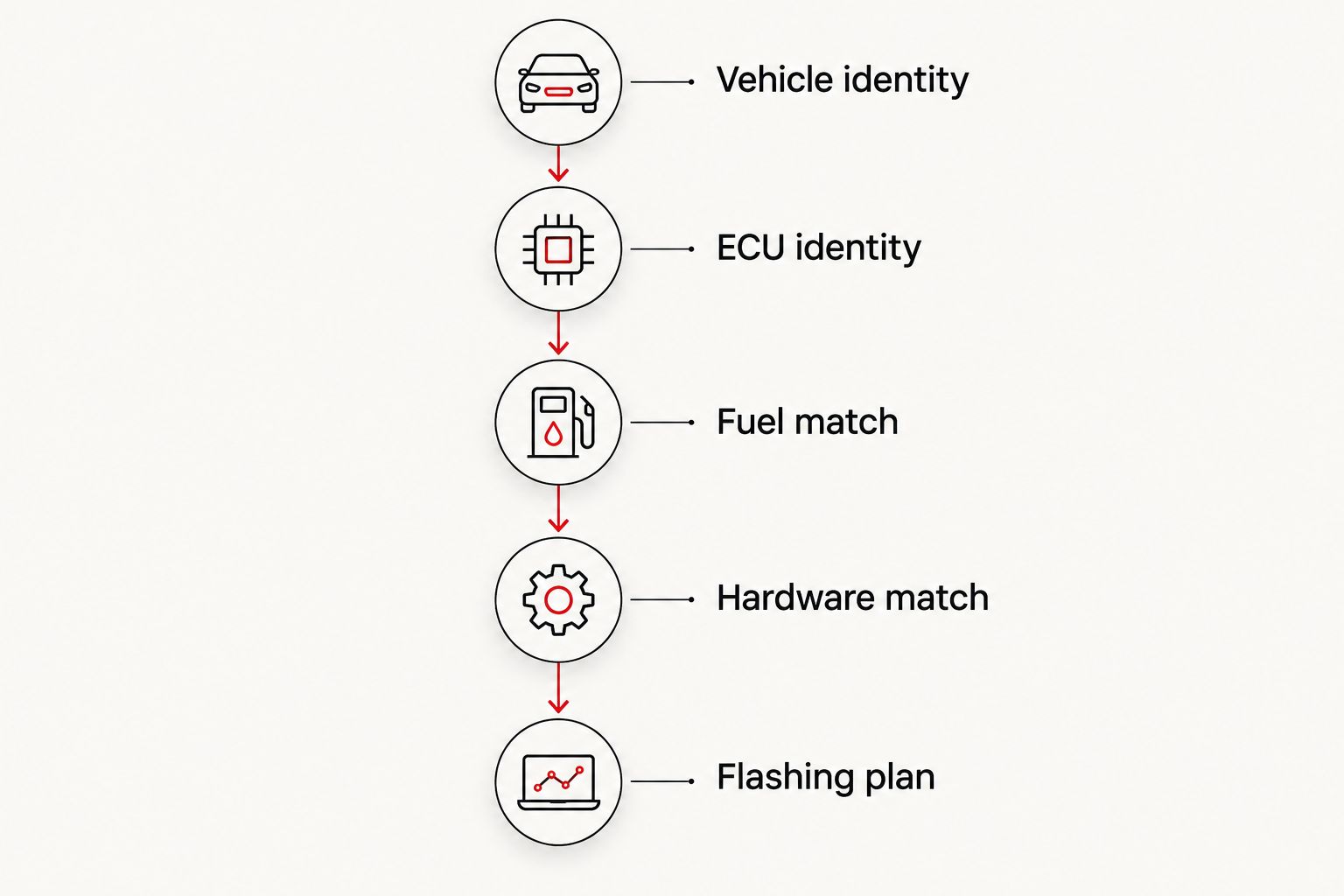
Send the information as one clear inquiry rather than separate guesses. A provider needs the car’s actual configuration, not just the result you want.
ECU tuning and TCU tuning are different purchases
ECU tuning changes engine-control software; TCU tuning changes transmission-control software. One is not evidence that the other is included or required.
| Software | Controls | Purchase question | Limitation |
|---|---|---|---|
| ECU calibration | Engine operation | Does this file support my engine ECU and configuration? | Does not establish transmission-software support |
| TCU calibration | Transmission operation | Is a transmission calibration required or offered for this setup? | Does not establish engine-calibration support |
Ask whether the proposed engine calibration requires a particular transmission-software configuration. Get an application-specific answer rather than assuming that every Audi transmission has the same requirements.
For daily use, discuss behavior as well as compatibility: response in traffic, shift behavior where relevant and diagnostic checks after installation. Keep engine and transmission deliverables distinct in the order details.
Installation questions that belong before checkout
Flashing requirements vary by ECU and delivery method. Do not assume every Audi 4.0T application uses the same at-home process, cable or access procedure.
Before purchasing, ask:
- Is installation performed through the diagnostic port, or does it require another access method?
- What computer, interface and software are required?
- What power-supply procedure must be followed?
- What should you do if communication or power is interrupted?
- What verification is required after flashing?
- What happens if a dealer later updates the ECU software?
Follow the provider’s written instructions rather than combining steps from unrelated tuning guides. In 2026, a familiar model badge still does not establish an identical flashing procedure.
How the routes are ranked
The ranking prioritizes a daily driver’s purchase decision: compatibility, available fuel, existing hardware, installation clarity and defined support. A documented stock-hardware route comes first because it addresses the owner who is not planning a hardware build.
Custom calibration ranks next for individual requirements. Hardware-specific tuning serves a committed modification plan, while factory calibration remains the correct fallback when the checks are incomplete. No route earns a purchase recommendation from an unsupported power claim.
Which Audi 4.0T tuning route should you choose?
Choose a documented stock-hardware ECU tune if you are keeping the existing engine hardware. Choose custom calibration when your configuration needs individual review, and a hardware-specific file only when the required parts are established.
For an ECAConcepts Audi 4.0T engine tuning inquiry, make compatibility confirmation the next step—not checkout based on an engine badge. Supply the vehicle details, ECU identification, fuel and installed hardware, then ask for the supported route.
Confirm your tuning requirements
Start with your vehicle, ECU identification, fuel and installed hardware.
FAQ
What’s the best ECU tune for an Audi 4.0T engine?
The best starting point for a daily driver is a calibration documented for its exact ECU, existing hardware and available fuel. Choose a custom or hardware-specific route only when its requirements match your configuration.
Does ECAConcepts support my specific Audi 4.0T?
Confirm your specific application with ECAConcepts before purchasing. Provide the vehicle details, ECU identification, installed hardware and intended fuel rather than relying on the engine designation alone.
Is a custom ECU tune better than a standard file?
A custom ECU tune is not automatically better than a documented standard file. Compare compatibility, included services, revision scope and suitability for your actual configuration.
Can I use either 91 AKI or 93 AKI fuel with a tune?
Use only fuel that meets the selected calibration’s documented requirements. Do not assume that a file intended for one grade accepts another grade or a differently expressed octane rating.
Do I need a TCU tune with an ECU tune?
A TCU tune is a separate transmission-software decision, not an automatic part of ECU tuning. Ask whether the specific engine calibration requires a particular transmission configuration.
Can I flash an Audi 4.0T ECU at home?
Confirm the installation method for your exact application before planning a home flash. The provider must specify the required access method, equipment, power procedure and recovery instructions.
Should I tune an Audi with warning lights or drivability problems?
Diagnose unresolved faults before purchasing a tune. A calibration change does not repair mechanical problems and adds another variable to troubleshooting.
One last thing
Write down the fuel requirement before you buy the file. Compatibility gets the calibration onto the car; the required fuel remains part of using it afterward. Make that requirement part of your final product inquiry, alongside ECU identity and hardware—not a question saved for installation day.
Related guides