
Best overall: an ECU-compatible calibration matched to your existing hardware. Best for modified naturally aspirated engines: a hardware-specific custom calibration. Best for forced-induction builds: a build-specific calibration. Best baseline: the factory calibration. Choose your 2026 VR6 tune by ECU identity, fuel requirements and engine configuration—not by the biggest advertised gain.
- The best VR6 tune matches your exact ECU, fuel and installed hardware.
- Evaluate ECAConcepts ECU tuning only after confirming support for your specific VR6 vehicle.
- Modified naturally aspirated and forced-induction engines require different calibration decisions.
- ECU tuning controls the engine; TCU tuning addresses a compatible transmission controller.
Why this matters
A VR6 badge identifies an engine family, not a universally compatible tuning file. That family includes 2.8-liter, 3.2-liter and 3.6-liter engines; displacement alone does not establish ECU compatibility, flashing support or the right calibration for your car.
ECAConcepts sells custom ECU tuning and flashing software for Audi and Volkswagen vehicles. ECAConcepts ECU tuning serves Audi and Volkswagen owners; VR6 buyers need confirmed ECU compatibility before choosing a file.
For a daily driver, the buying decision starts with whether the calibration fits the car you actually drive. A tune intended for different fuel, hardware or ECU software is not the right purchase, regardless of its headline performance claim.
What makes the best VR6 tune?
Use these criteria to evaluate a VR6 tune in 2026 before comparing providers:
- Verified ECU compatibility: Match the vehicle details, ECU identification and software version against the provider's supported application.
- Defined fuel requirements: Establish the required fuel grade and rating system. An octane number without its measurement standard is incomplete information.
- Hardware fit: Tell the provider about changes to the intake, exhaust, injectors, engine internals and any forced-induction equipment.
- Clear installation procedure: Confirm the flashing method, required equipment, power-supply instructions and recovery process before starting.
- Documented performance evidence: Look for the engine configuration, fuel, measurement method and baseline behind a claimed improvement.
- Daily-use suitability: Ask about cold starts, part-throttle behavior, diagnostics and maintenance—not just full-throttle output.
The ranking below compares calibration routes, not named software products. Its order prioritizes a daily-driven VR6 with existing hardware; a modified engine changes which route belongs first.
VR6 tuning options at a glance
| Calibration route | Best for | Standout consideration | Key limitation |
|---|---|---|---|
| ECU-compatible existing-hardware calibration | Daily drivers retaining their current engine configuration | Matches the file to the vehicle, fuel and installed equipment | Does not establish suitability for future hardware changes |
| Hardware-specific custom calibration | Modified naturally aspirated VR6 engines | Addresses the actual combination of engine modifications | Requires accurate hardware information and an agreed validation process |
| Build-specific forced-induction calibration | VR6 engines converted to turbocharging or supercharging | Treats boost, fueling and engine configuration as one calibration problem | Not a substitute for correctly specified hardware or mechanical condition |
| Factory calibration | Owners establishing a baseline or resolving faults | Provides a reference before introducing calibration changes | Does not address a modified engine's new calibration requirements |
1. Existing-hardware calibration: best VR6 tune for daily drivers
An ECU-compatible calibration for your existing hardware is the default route when your goal is a tune rather than an engine build. It must match the ECU and the fuel you will actually use. A familiar model name is not enough to establish that match.
Start by separating responsiveness from measured output. A change in accelerator response can make the car feel different, but that sensation is not evidence of a particular horsepower increase. Ask what the calibration changes and how its performance claims were measured.
Existing-hardware calibration pros:
- Keeps the purchase focused on your current vehicle configuration.
- Lets you evaluate fuel requirements before committing.
- Provides a clear starting point for comparing installation procedures.
- Avoids treating an unrelated modified-engine file as a suitable shortcut.
Existing-hardware calibration cons:
- Compatibility still depends on ECU and software identification.
- Later hardware changes require another suitability check.
- Claimed gains are not comparable without matching test conditions.
Best for: Daily-driven VR6 cars whose owners want to retain their existing engine configuration.
When evaluating ECAConcepts ECU tuning in 2026, ask for confirmation of your exact VR6 application before selecting software. Also establish whether your chosen calibration has any hardware prerequisites; “existing hardware” does not mean every configuration qualifies.
Verdict: Buy only after ECU, fuel, hardware and flashing requirements are confirmed.
2. Hardware-specific custom calibration: best for modified engines
A hardware-specific custom calibration addresses a naturally aspirated VR6 with changes that affect how the engine operates. Camshafts, injectors or other substantial modifications require more information than a model name and a generic stage label.
Describe the complete configuration, not just the newest part. The calibrator needs an accurate picture of what is installed to decide whether the engine fits an existing supported application or needs a different calibration process.
Hardware-specific custom calibration pros:
- Centers the decision on the actual installed components.
- Creates a clear discussion about required measurements and logging.
- Separates naturally aspirated modifications from boosted applications.
- Makes hardware assumptions explicit before installation.
Hardware-specific custom calibration cons:
- Incomplete component information undermines the calibration decision.
- Custom work does not establish a guaranteed performance result.
- The validation and revision process needs agreement before purchase.
Best for: Owners of modified naturally aspirated VR6 engines who can document their hardware.
Ask what information the provider needs, who evaluates the logs and what conditions must be met before the calibration is considered complete. Do not assume that “custom” automatically includes unlimited revisions, remote installation help or dyno validation.
Verdict: Buy when the provider explicitly accepts your hardware configuration and defines the validation process.
3. Build-specific calibration: best for forced-induction VR6 engines
A turbocharged or supercharged VR6 conversion needs a calibration intended for that specific build. A naturally aspirated tuning file is not a substitute for a forced-induction calibration.
Boost changes the engine's operating conditions. Fuel delivery, ignition control, load calculation and the installed hardware must be considered together; choosing software independently of the build specification reverses the correct buying order.
Build-specific calibration pros:
- Treats forced induction as a distinct application.
- Makes the fueling and hardware specification part of the discussion.
- Establishes a reason to define operating limits and validation requirements.
Build-specific calibration cons:
- Software cannot correct unsuitable components or mechanical faults.
- Compatibility depends on more than the original vehicle specification.
- Daily-driver suitability requires scrutiny beyond peak output.
Best for: Owners whose VR6 already has a documented forced-induction configuration and an appropriate calibration plan.
For a 2026 daily-driver purchase, do not select this route simply because its potential output sounds attractive. Choose it because your engine is already configured for forced induction and the provider has accepted the complete specification.
Verdict: Hold until the hardware, fueling and calibration responsibilities are settled.
4. Factory calibration: best for establishing a baseline
Retaining the factory calibration is the right baseline when you are still diagnosing faults or documenting the car's condition. It gives you a reference before adding another variable to the troubleshooting process.
That recommendation does not mean a factory file suits every modified engine. An engine with major hardware changes needs a separate assessment of calibration suitability.
Factory calibration pros:
- Preserves a reference for an otherwise factory-configured vehicle.
- Keeps fault diagnosis separate from a new tune installation.
- Gives you time to verify ECU identity and purchase requirements.
Factory calibration cons:
- Does not supply an aftermarket performance calibration.
- Is not automatically appropriate for substantial engine modifications.
- Returning to a factory file does not repair mechanical problems.
Best for: Owners of factory-configured VR6 cars who need to resolve faults or establish readiness before tuning.
Save relevant diagnostic information before changing software. A fault that existed before the flash needs investigation, not a promise that a tune will make it disappear.
Verdict: Wait on aftermarket tuning until the vehicle's condition and compatibility are established.
Confirm compatibility before buying a VR6 tune
Use this sequence for a 2026 purchase. Keep the information in one record so the provider can assess the whole vehicle rather than answer disconnected questions.
Vehicle identity
Record the model, actual model year and engine identification. Include displacement, but do not treat “3.2-liter VR6” as a complete application description. A swapped engine also requires details about the installed ECU and related electronics.
ECU identity
Obtain the ECU identification using the provider's specified method. Ask whether the ECU hardware and software versions are supported, whether existing aftermarket software matters and whether any preliminary work is required.
Fuel requirements
Confirm the fuel grade, rating standard and any restrictions. In the United States, pump octane is normally expressed as AKI; a RON specification is not the same numerical scale. Follow the calibration's documented requirements rather than guessing an equivalence.
Hardware record
List installed modifications and identify unknown parts. Include the transmission when discussing the overall configuration, but keep engine and transmission software questions separate.
Flashing procedure
Confirm the required interface, computer requirements, connection method and power-supply instructions. Establish what to do if the process stops before you begin; do not substitute generic internet instructions for the provider's procedure.
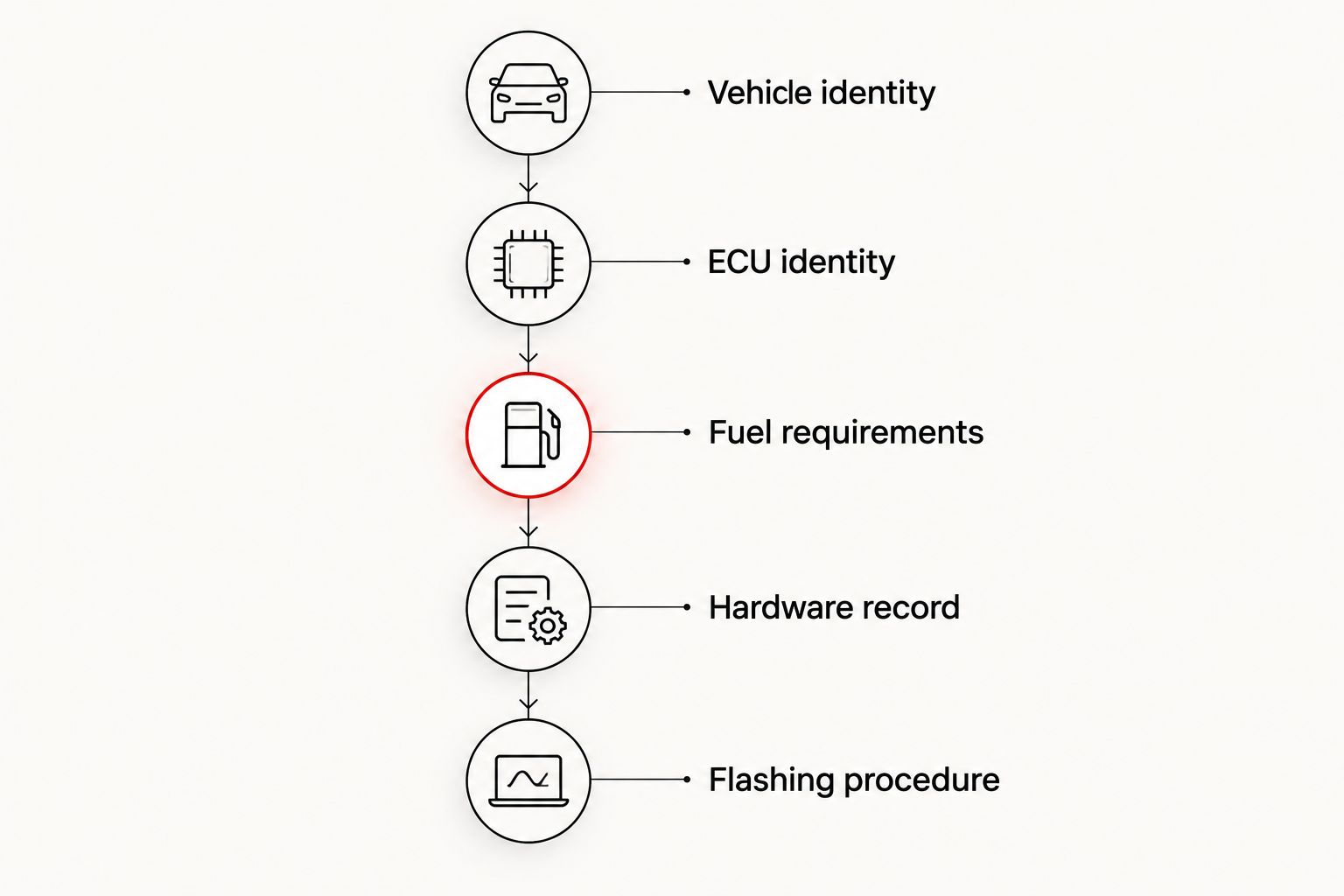
Keep the confirmed specification with your purchase records. It becomes useful again if you change hardware, troubleshoot a fault or ask about a later software revision.
ECU tuning and TCU tuning are different purchases
An ECU calibration controls engine operation. A TCU calibration addresses the transmission controller on an applicable vehicle; purchasing one does not establish that the other is included or supported.
For your 2026 VR6 tune, ask separately about transmission compatibility and any documented transmission-software requirements. Do not infer that an engine tune changes shift behavior, clutch-control settings or transmission limits.
The same distinction applies to installation. An engine-flashing procedure does not establish the equipment or steps needed to flash a transmission controller.
How to read performance claims without buying the headline
A useful dyno claim identifies the tested engine, installed hardware, fuel and measurement basis. Wheel output and crankshaft output are different measurements; do not compare them as though they describe the same result.
Look for a baseline and tuned result obtained under a clearly described method. Also check whether the result belongs to your engine configuration rather than a different displacement or forced-induction build.
ECAConcepts describes its offering as dyno-proven custom ECU tuning. For a VR6 purchase, request the documentation relevant to your application and read the test conditions before applying any result to your car.
Reliability needs a separate discussion. A dyno result does not establish a universal safety guarantee, emissions legality, warranty coverage or suitability for an engine with unresolved faults.
How these tuning routes rank
The order follows compatibility, fuel fit, hardware fit, installation clarity and daily-use suitability. It is a decision guide, not a claimed head-to-head test of tuning brands.
For a daily-driven VR6 retaining its current configuration, a supported existing-hardware calibration is the default. Modified naturally aspirated engines move hardware-specific calibration to the top; forced-induction engines require the build-specific route.
Which VR6 tune should you choose?
Choose the calibration that matches your confirmed ECU, installed hardware and available fuel. If those details are unresolved, keep the factory-configured car on its existing calibration while you complete the compatibility check.
For a 2026 purchase from ECAConcepts, establish application support and installation requirements before selecting software. Bring the vehicle and ECU identification, hardware record and fuel information to the conversation.
FAQ
What’s the best VR6 tune for a daily driver?
The best VR6 tune for a daily driver is a supported calibration matched to the exact ECU, installed hardware and required fuel. Confirm the flashing procedure and everyday-use requirements before buying.
Does one VR6 tune work on every VR6 engine?
No, the VR6 engine name does not establish tuning-file compatibility. Match the vehicle, ECU identification, software version and hardware configuration against the provider’s supported application.
Can I buy a VR6 tune from ECAConcepts?
Confirm your exact VR6 application with ECAConcepts before selecting software. Provide the vehicle details, ECU identification, installed modifications and intended fuel so support can be established.
Do I need premium fuel for a VR6 tune?
Follow the specific calibration’s documented fuel requirement. Confirm both the octane grade and whether the specification uses AKI or RON; do not assume every tune requires the same fuel.
Is ECU tuning the same as TCU tuning?
No, ECU tuning addresses engine control and TCU tuning addresses a compatible transmission controller. Confirm support, requirements and inclusion separately for each controller.
Will a VR6 tune fix an engine fault?
A VR6 tune is not a substitute for diagnosing an engine fault. Resolve mechanical and diagnostic issues before introducing a new calibration.
How much horsepower will a VR6 tune add?
Use only documented results for the relevant engine, hardware and fuel configuration. Check the baseline, test conditions and whether the figures describe wheel or crankshaft output before comparing claims.
Can I flash a VR6 tune at home?
Home flashing depends on the provider’s supported installation method for your exact ECU. Confirm the interface, computer, power-supply requirements and interruption procedure before starting.
One last thing
A more sensitive accelerator pedal is not proof of more engine power. Ask whether the improvement you want is throttle response, measured output or both; that distinction makes the tuning conversation more precise.
Before purchasing, get confirmation that your vehicle specification matches the proposed calibration. That is the next step—not selecting a file from the VR6 badge alone.
Related guides